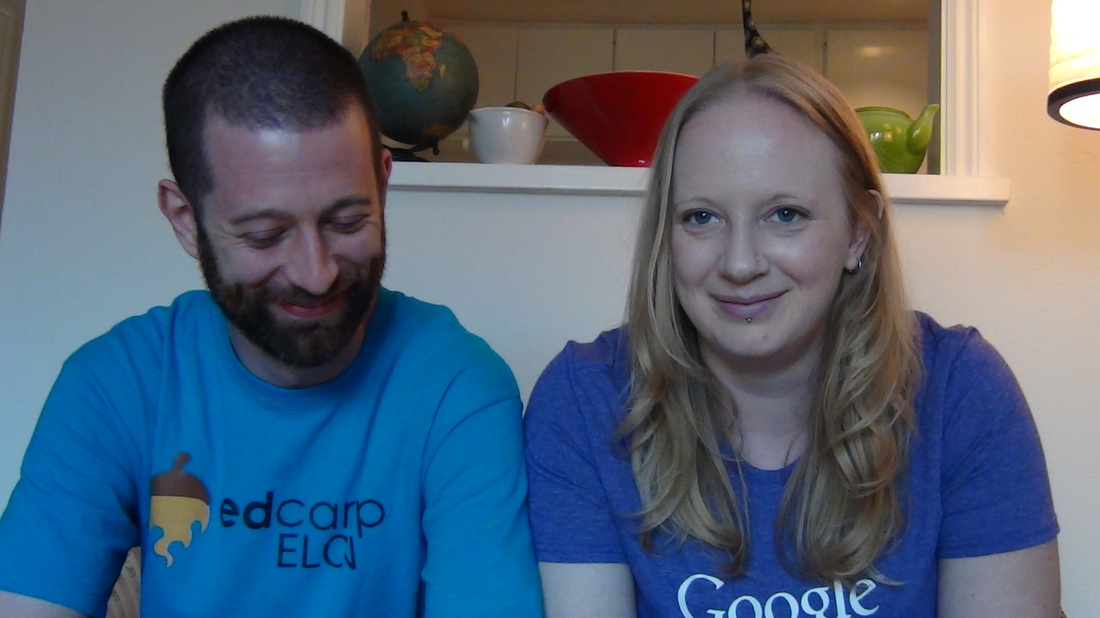
On Saturday, I had the great honour to co-present with about flipped English at the Michigan Flipped Learning Conference. Obviously Andrew presented with me (we really don't tend to do things separately, if you haven't figured that out by now), but we were joined by April Gudenrath - the most experienced English flipped teacher there is - as well. The hangout was broadcast and can be seen in its entirety here, and you can view our presentation through Google Drive here, and you can fill out the Flipped English Teacher Community form here so we can get a good list of as many flipped ELA teachers as possible.
Anyway, most of the questions we got this weekend at #MIFlip (and on Twitter afterward) were around how you get started with flipping. The school year has already started, so that ship has already sailed for this year, right?
I would argue that mid-year is actually a BETTER time to flip than the beginning of the year. The kids know you. They trust you. They believe that you are out for their best interests and care about you. You get to start ahead. As many of us found out this year, jumping into the flip with new students is really, really difficult.
So you're convinced you want to try something. But you're not sure if it'll take, or if you'll have enough time, or how you should start. Let me see if I can help.
There are a few main models:
Most of us start at Flip 101 - I did. And if you use a lot of direct instruction, that's where I think you SHOULD start. Take those lectures you always give (as April calls them, "points of pain") or instructions you have to repeat over and over, and put them on video. If you have an iPad, use ShowMe. If you have a Mac, open PhotoBooth (so your face is on screen) and capture your screen with QuickTime (every newish Mac comes with it, and it's free). If you don't have either, use one of the free services online - ExplainEverything, Jing, Screen-Cast-O-Matic, etc. I've used them all, but I prefer ShowMe for quick stuff, and Camtasia for everything else.
If you feel like adding in direct instruction would be taking a step backwards pedagogically, then start by starting the shift to asynchronous or mastery. Use video where and when you can, but focus on getting students to be responsible for themselves and their learning - that's the first flip.
The way you do that depends on your students and what they need. You need to use class time in the best possible way, with the intention of creating opportunities in the classroom for collaboration between students, and the availability of the teacher and peers to help. For Andrew and me, that means using class time to let our students compose in class, do close-reading, work on collaborative projects, and having discussions as a class. The way you use class time is FAR more important than what you put on video. Video, like all technology, is just a tool to help your students learn best. Don't make video the point; make it the process.
**
When you've gotten your feet a little wet under one or more of those models, you pretty much have to move on to Co-Flip. Flipped learning is WAY too hard to do it on your own. I don't have any colleagues flipping (or interested in flipping) in my department or school. But less than an hour away, there are dozens of flipped teachers - even a few who flip English. And when I broaden the search a little, I find people who not only want to do what I'm doing, but they can push me to get better at what I'm doing.
I know I'm kind of a one-trick pony in this regard, but my classroom didn't really get to the point I knew it could until I met Andrew. Then came Karl, and Carolyn, and Crystal, and Brian. Then came the other Co-Flippers: Delia, Lindsay, and Audrey...and the rest of the Flipped ELA gang (see many of us discussing flipped writing here): Kate B, Kate P, Dave, Troy, Shari, Katie R, April, Sam, Natalee...and more I'm probably forgetting. All of those people have helped me shape the way I think about flipping, and the experience of flipping in my classroom.
There is no way I would be the teacher I am now without them, and I'm lucky to have a PLN that not only supports me and gives me ideas, but will discuss tattoo design until ridiculous o'clock, or run up my tweet total to 5k (special thanks to Sam for that one!) or just be silly and join the #HashtagRevolution. I'm lucky to have Andrew as a #CoLab partner (get it? Lab partner, only COlLABorative? Yeah, I know I'm #EduAwesome at wordplay). I'm lucky to have a #CoLab partner who will be as pissed off about the things that I'm pissed off about, but will help me calm down and reason through it. I'm lucky to have a #CoLab partner who will spend a whole day building a website that we can't actually use, and then will throw it out and start again without looking back. I'm lucky to have a #CoLab partner who understands my strengths and weaknesses better than I do.
Andrew makes me better.
Don't believe us? Ask Katie Regan and Shari Sloane (and now Dave Constant, who has joined them as the #ladygeeksanddave) why #coflip is better than any other flip. Ask Carolyn Durley and Graham Johnson why #coflip has kept them sane. It's not just the intellectual and practical support. It's the personal support. We care about each other, We care for each other. We're friends first, collaborative partners second.
So once you've decided what kind of flipped model will fit your classroom best, find someone who will help you do it even better. Ask questions. Jump in on conversations on Twitter. Join the Flipped English group on Twitter. Get on the Ning for Flipped Learning. Post here.
Start a conversation. And don't wait for a "more convenient time" - start now, where you can. Don't make yourself crazy trying to do everything - but find people who have already done it. Listen and take whatever they offer. You don't have to use it for it to be worthwhile for you. And if you annoy someone by asking too many questions, they probably aren't the person you want to work with anyway. We're all adults, and personality does make a big difference. Find people you genuinely like and then see what you can get, and what you can give.
Without Andrew, I would have given up a long time ago. I never would be presenting at conferences, or writing a few chapters for an upcoming book about flipped learning, or reaching my students in the most effective ways. No matter how crazy I make him, or he makes me, our collaboration is worth it. Neither of us could do this alone.
And neither should you.
Anyway, most of the questions we got this weekend at #MIFlip (and on Twitter afterward) were around how you get started with flipping. The school year has already started, so that ship has already sailed for this year, right?
I would argue that mid-year is actually a BETTER time to flip than the beginning of the year. The kids know you. They trust you. They believe that you are out for their best interests and care about you. You get to start ahead. As many of us found out this year, jumping into the flip with new students is really, really difficult.
So you're convinced you want to try something. But you're not sure if it'll take, or if you'll have enough time, or how you should start. Let me see if I can help.
There are a few main models:
- Flip 101 - take your direct instruction and put it on video. Have the kids watch the video at home. Use class time to help them get more in-depth with reading, writing, projects, or discussion.
- Asynchronous Flip - use video in class or as a supplement to what you would normally do. Put your novel reading on video and use todaysmeet.com to have a live discussion. Let kids work through curriculum at their own pace, where students can work ahead but can't get behind. Video is one way of accessing the content, and students can choose others, so long as they can demonstrate learning.
- Flipped Mastery - using either of the two models with the integration of mastery or Standards Based Grading (SBG) to assess student learning.
- Co-Flip - short for Collaborative Flip. This model is student-centred, where instruction takes place if/when needed, and may or may not be on video. It could be asynchronous or synchronous. It could be self-paced or with everyone at the same pace. It could use mastery or SBG or neither. But the most important elements are 1) student-centred pedagogy, 2) use of higher order thinking, and 3) deep value in and use of collaboration, between teacher and student, student and student, and teacher with other teachers.
Most of us start at Flip 101 - I did. And if you use a lot of direct instruction, that's where I think you SHOULD start. Take those lectures you always give (as April calls them, "points of pain") or instructions you have to repeat over and over, and put them on video. If you have an iPad, use ShowMe. If you have a Mac, open PhotoBooth (so your face is on screen) and capture your screen with QuickTime (every newish Mac comes with it, and it's free). If you don't have either, use one of the free services online - ExplainEverything, Jing, Screen-Cast-O-Matic, etc. I've used them all, but I prefer ShowMe for quick stuff, and Camtasia for everything else.
If you feel like adding in direct instruction would be taking a step backwards pedagogically, then start by starting the shift to asynchronous or mastery. Use video where and when you can, but focus on getting students to be responsible for themselves and their learning - that's the first flip.
The way you do that depends on your students and what they need. You need to use class time in the best possible way, with the intention of creating opportunities in the classroom for collaboration between students, and the availability of the teacher and peers to help. For Andrew and me, that means using class time to let our students compose in class, do close-reading, work on collaborative projects, and having discussions as a class. The way you use class time is FAR more important than what you put on video. Video, like all technology, is just a tool to help your students learn best. Don't make video the point; make it the process.
**
When you've gotten your feet a little wet under one or more of those models, you pretty much have to move on to Co-Flip. Flipped learning is WAY too hard to do it on your own. I don't have any colleagues flipping (or interested in flipping) in my department or school. But less than an hour away, there are dozens of flipped teachers - even a few who flip English. And when I broaden the search a little, I find people who not only want to do what I'm doing, but they can push me to get better at what I'm doing.
I know I'm kind of a one-trick pony in this regard, but my classroom didn't really get to the point I knew it could until I met Andrew. Then came Karl, and Carolyn, and Crystal, and Brian. Then came the other Co-Flippers: Delia, Lindsay, and Audrey...and the rest of the Flipped ELA gang (see many of us discussing flipped writing here): Kate B, Kate P, Dave, Troy, Shari, Katie R, April, Sam, Natalee...and more I'm probably forgetting. All of those people have helped me shape the way I think about flipping, and the experience of flipping in my classroom.
There is no way I would be the teacher I am now without them, and I'm lucky to have a PLN that not only supports me and gives me ideas, but will discuss tattoo design until ridiculous o'clock, or run up my tweet total to 5k (special thanks to Sam for that one!) or just be silly and join the #HashtagRevolution. I'm lucky to have Andrew as a #CoLab partner (get it? Lab partner, only COlLABorative? Yeah, I know I'm #EduAwesome at wordplay). I'm lucky to have a #CoLab partner who will be as pissed off about the things that I'm pissed off about, but will help me calm down and reason through it. I'm lucky to have a #CoLab partner who will spend a whole day building a website that we can't actually use, and then will throw it out and start again without looking back. I'm lucky to have a #CoLab partner who understands my strengths and weaknesses better than I do.
Andrew makes me better.
Don't believe us? Ask Katie Regan and Shari Sloane (and now Dave Constant, who has joined them as the #ladygeeksanddave) why #coflip is better than any other flip. Ask Carolyn Durley and Graham Johnson why #coflip has kept them sane. It's not just the intellectual and practical support. It's the personal support. We care about each other, We care for each other. We're friends first, collaborative partners second.
So once you've decided what kind of flipped model will fit your classroom best, find someone who will help you do it even better. Ask questions. Jump in on conversations on Twitter. Join the Flipped English group on Twitter. Get on the Ning for Flipped Learning. Post here.
Start a conversation. And don't wait for a "more convenient time" - start now, where you can. Don't make yourself crazy trying to do everything - but find people who have already done it. Listen and take whatever they offer. You don't have to use it for it to be worthwhile for you. And if you annoy someone by asking too many questions, they probably aren't the person you want to work with anyway. We're all adults, and personality does make a big difference. Find people you genuinely like and then see what you can get, and what you can give.
Without Andrew, I would have given up a long time ago. I never would be presenting at conferences, or writing a few chapters for an upcoming book about flipped learning, or reaching my students in the most effective ways. No matter how crazy I make him, or he makes me, our collaboration is worth it. Neither of us could do this alone.
And neither should you.
 RSS Feed
