TMI Flips English
  • Welcome!
  • Blog
  • Thomasson Morris Instruction
  • About Me
  • Contact Me

Definition Essay Ideas and Insecurities

7/7/2012

0 Comments

 
So one of my biggest challenges in switching from my home of four years, San Lorenzo High School, to my new home, Redwood High School, is that I will now be in charge of planning my own curriculum.  I used to do that, but when I moved to SLz, everything was planned collaboratively.  It taught me a lot about scaffolding and structure, and I am SO thankful that I learned so much while I worked there.

But Redwood isn't just asking me to plan my own curriculum - they want me to plan curriculum for three different upper-division electives (for 11th-12th graders) at a college level.  Seriously.  Last night, I brought some of the texts I'm using over to my church home group, and everyone said something like, "That's for high school students?  I didn't read that until nearly the end of college!"

One of the biggest challenges is a class called Essay and Exposition.  It's not quite an AP class, but it's still the "best and brightest" in the school who sign up.  

That being said, I was reading a fantastic article by Mike Fisher, called Snapshot of a Modern Learner.  If you haven't read it, you should.

The basic premise of the essay is that the modern learner approaches learning differently than school offers it.  

That got me thinking...what if I had students read the article and then write a portrait of themselves as a learner in the style of Fisher's essay?

It serves myriad purposes:
  • working on style imitation, which is a goal of the class
  • it tells me about them and their own learning context
  • it leads into the unit on definition essays


It also ties in nicely with my White Blank Page project and the goals of a flipped class.  I think part of why I'm freaking out about this year is because I want to have something planned out fully and I don't.  But I also know that personalisation is a major factor in my flipped class, and without knowing the students, I don't know what they need.  Those two competing forces have made my head a really unpleasant place the last few weeks (and I'm sorry to my friends who've had to hear verbalise the neurotic personality inside my head).

In fact, Crystal Kirch, Karl Lindgren-Streicher and I were talking about planning for the year last night on Twitter.

@guster4lovers @kls4711 @thomasson_engl lol. I want to get a big piece of poster paper and take over my kitchen table to map it all out. :)

— Crystal Kirch (@crystalkirch) July 7, 2012
Planning for a flipped class is really, really hard.  And even more so in English.  I mean, I can prepare content (see: Thomasson and Morris Instruction), but I can't prepare for what they know and what they will need to know.  That is only compounded by the fact that I have a very vague sense of Redwood's school culture and student makeup. 

******

I'm not sure how this post descended into my own insecurities.  It probably has to do with the fact that, as a learner, I always feel like I should know more than I do.  I always feel like I am so far behind everyone else that I'll never catch up.  There are reasons for that (none are relevant for the purposes of this post), but it certainly impacts how I teach.  

I think I need to write my own "Snapshot of a Modern Learner" essay first.  
0 Comments

Patterning Fiction

7/7/2012

0 Comments

 
Patterns are everywhere.  Whether we realise it or not, our life is dominated by and surrounded with patterns.  

Teaching students to harness the power of patterns to help them make sense of reading, writing, and critical thinking gives them a toolkit that will allow them to understand the entire world.

The way I teach my system, which I simply call "Patterning," is fairly straight forward.  And what I realised is that it's Explore-Flip-Apply without me even knowing it.  There are two systems, one for shorter works (generally it works best with non-fiction), and one for longer works.  I'll describe my system for longer works first, and I'll address the other system in another post soon. 

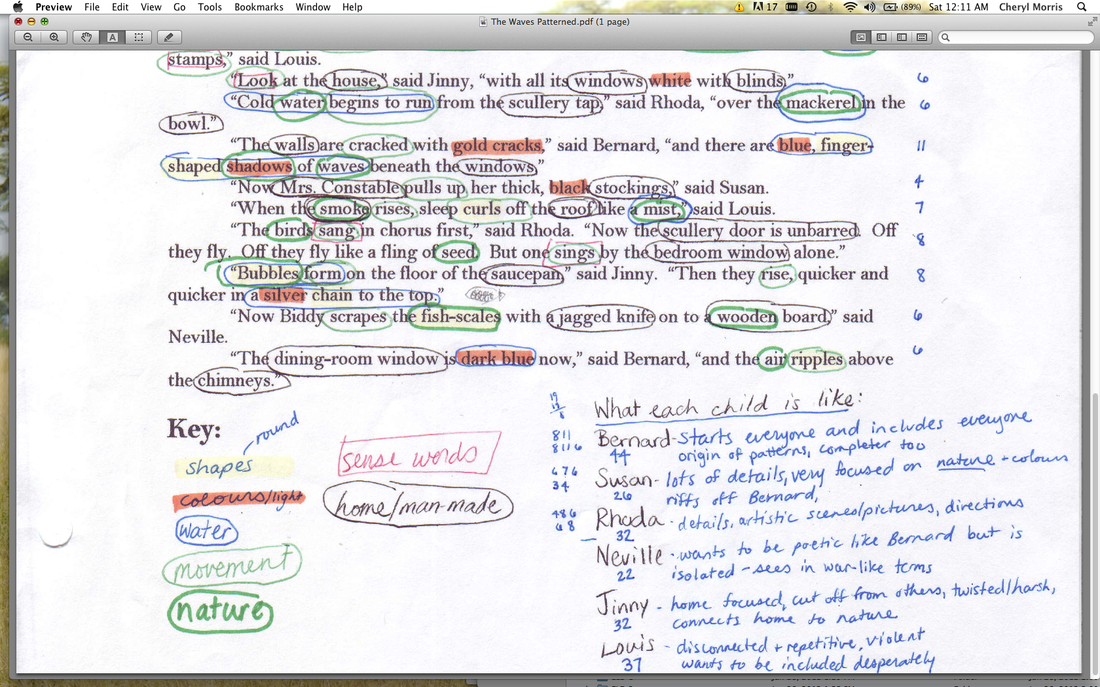
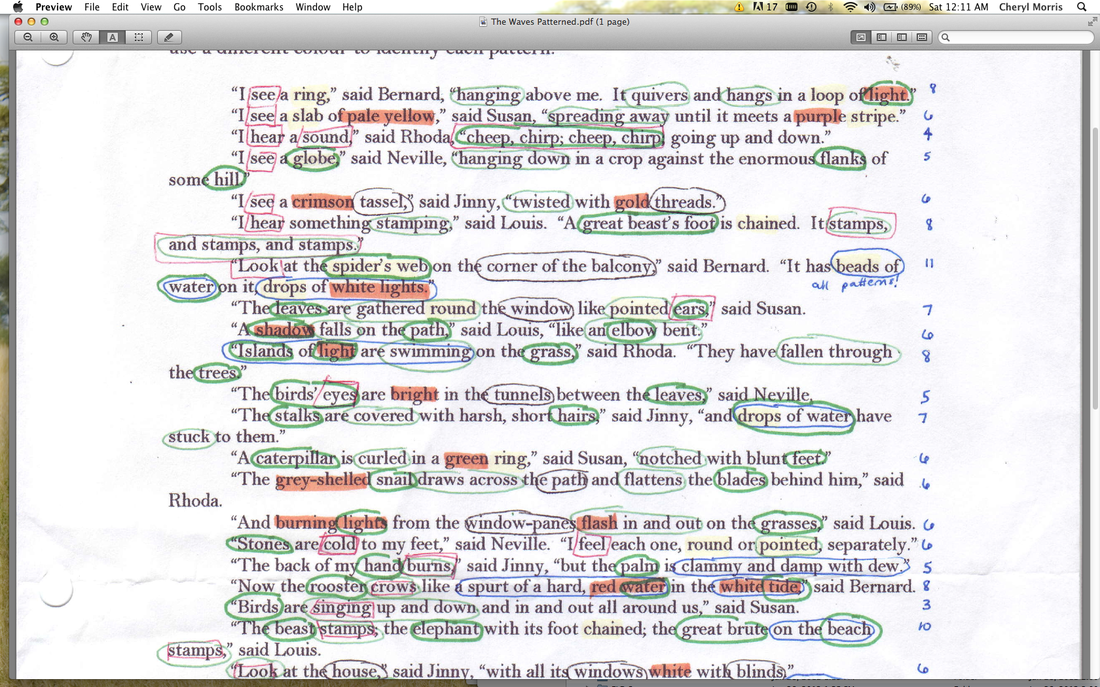
I could go on and on in words, but I think it's much easier to understand Patterning if you look at this document:
Picture
Picture
That is the first page in Virginia Woolf's The Waves.  You can see that we found and traced seven patterns.  Some of those are the ones that I showed them (shapes and colours), and the rest are student-found patterns.  

Here are the instructions I gave:
Anytime an author uses a word, it is intentional.  They thought about that word and the way in which it fits in to the entire work.  They use related words, phrases, images, and ideas to create patterns.  In this section, there are lots of patterns - your job is to find them.  If you think it's a pattern, it probably is.  

Then I give them about 10 minutes and instruct them to mark them in different colours.  A requirement of my class is that they have 5-6 colours of highlighters.  Short of having all my students on iPads with Notability, I'm not sure I can make that part digital...yet.

After they found patterns, they shared out with the class.  You'll notice that some patterns intersect, but that's okay.  I love using Virginia Woolf for this exercise because her writing is so freaking intentional.

*******

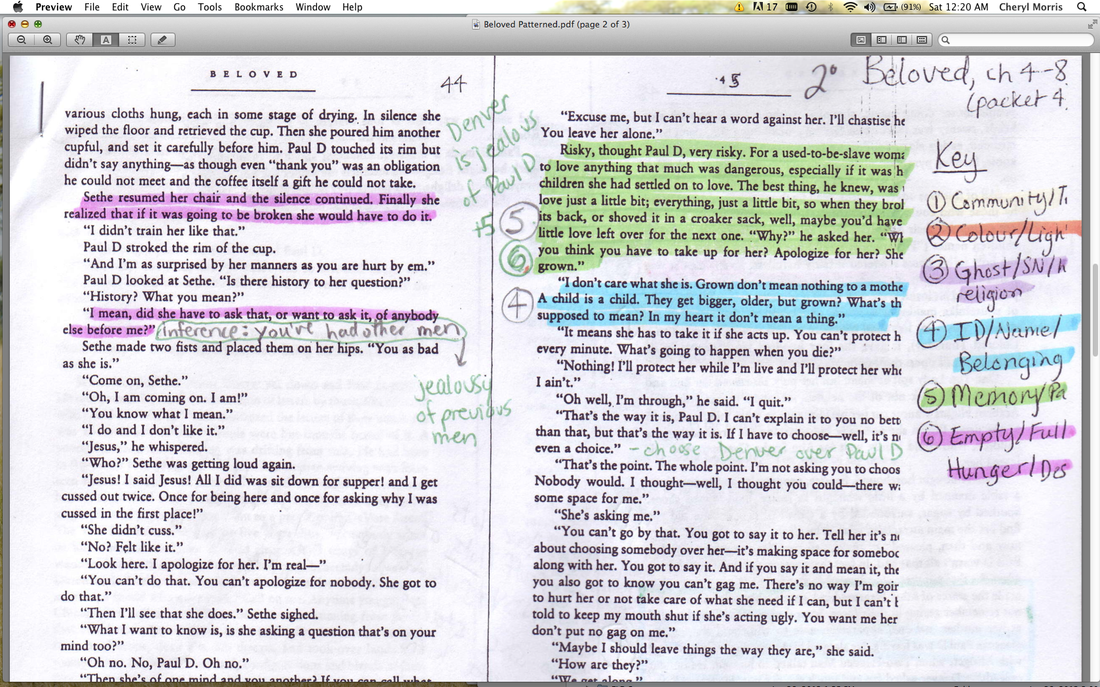
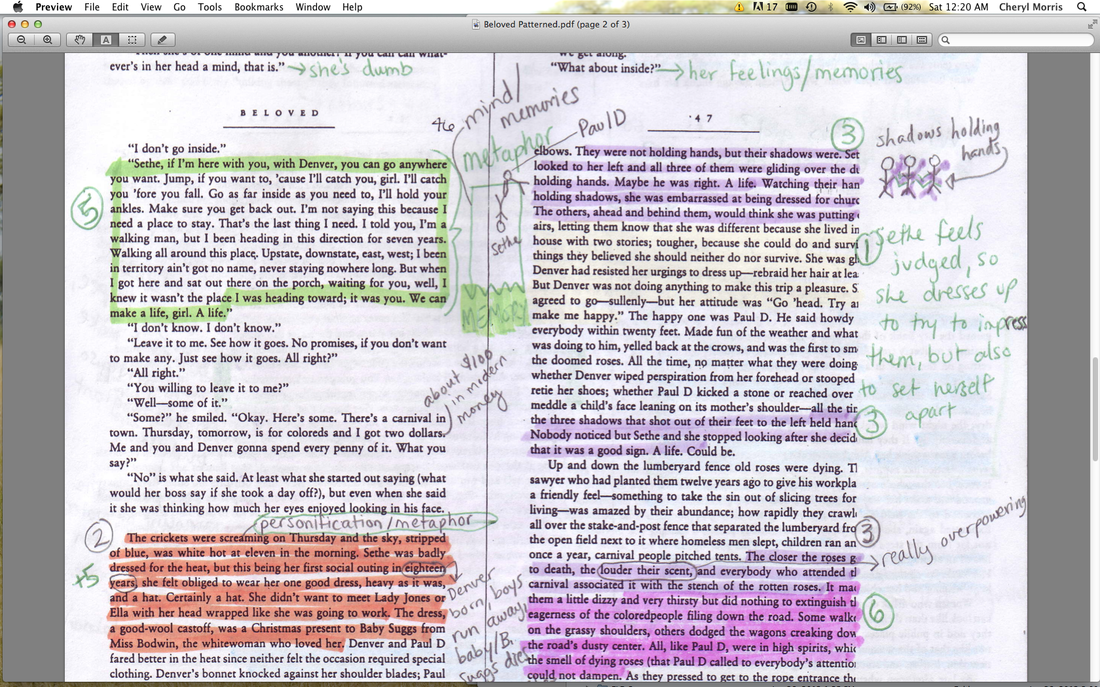
In a novel, I'll sometimes give them the patterns ahead of time, and have them trace them through the work.  Here's an example from Toni Morrison's Beloved, which I taught to 11th graders in summer school last year:
Picture
Picture
You can see the pattern groups at the top of the page.  

Yes, I photocopied the entire book for my students.  But it only took 30 pieces of paper for the whole novel because I put 8 book pages on a single sheet of paper.  And I wasn't allowed to bring them from my school to the SS school site, so it was the best option I had.


After we read a section, I would give students time to find ANY evidence of their pattern and highlight it.  Then they would choose their Crystal Quotes - the one or two quotes per section that best illustrated their pattern.  When they were ready, they would come mark them on the class copy.  After all groups were ready, we marked them up as a group so all students had all the Crystal Quotes for every pattern in their packet.


You can probably see the +5 next to some highlighting.  The way I motivated groups to find the best quotes was that I chose two  Crystal Quotes of my own, and if they chose the same ones as me, I gave them extra credit points.


********


So basically, they're finding evidence of a theme, but I'm not using the word "theme" because it's unnecessary.  And when the time comes to write the essay for the novel, they have already selected all of their evidence for a variety of themes.  


I'm sure I'm not explaining it perfectly, but that's my system.  My kids find it incredibly useful, because finding "patterns" is so much more concrete than "analysing a theme" or "choosing evidence to prove a claim" (but it's the same thing).


This system also fits in to my first day activity (White Blank Page - if you haven't read it, you should!).  When I pull them out to do their video interviews, I'm looking for their ability to make inferences and find patterns.  We'll cover the explicit vs. implicit evidence, finding patterns in their own life and in the world around them, and how to apply that to reading, writing, and thinking.  


I'll probably show Derren Brown's AMAZING TV show, The Heist to show them how  one person manipulates others using only patterns.  I am (not so) secretly in love with Derren Brown (side note: he's British, but some of his work is about to be put on Hulu!!!!  You should definitely check him out...you will be entertained and amazed).


Then we'll use those skills in the research unit and in the White Blank Page project I talked about in the last post.  And thanks to Karl for posting the Google Doc description we (really, he) wrote.  I didn't have permission to share it... :-)

In terms of how to use this in my flipped class, I think I'll push all the "here's how you use this system" to video, and then have them mark it up for homework, rather than in class.  That way we can spend class time discussing and analysing the text.  If my guiding question is "How do I use my face-to-face time most effectively?" then I think the best use of in class time is not having them highlight for 30 minutes.

In the next post, I will probably cover my text-coding pattern system.  Probably.  
0 Comments

Why I <3 Twitter (& why u should 2)

7/3/2012

15 Comments

 
Now, I've talked about my on-going love affair with Twitter on this blog before.  The #flipclass Monday chats.  The amazing meeting of the minds.  Following #flipcon12 and #iste12 from 2500 miles away.

But the reason why I think Twitter is one of the best things ever is not about any of those things.  Here are two examples to prove my claim that Twitter is awesome:

1. When I got my first negative blog comment, my PLN on Twitter was there to reassure me, help me put it in perspective, and move on from it.

But more important than that...

2. Twitter is where I met my #flipclass partner in crime, Andrew Thomasson.  

It's hard to believe that a week ago, I didn't know him at all.  Now we've filmed and edited over an hour's worth of instruction for our series on writing a research paper, and we have even more ambitious plans in the works.

We "met" because we were following the #flipcon12 virtual action and were both looking for someone with whom we could partner to make skill videos for our students.  After a really productive FaceTime session, we put together an outline of the videos/skills we needed to cover, and then on Saturday, we jumped right in...unaware that what we were doing was about to change everything.

We asked ourselves this main question: What skills or topics can we cover more effectively together than we could on our own?

The answer turned out to be the writing process, in its many iterations.  So that's where we started.

The first video was great.  The second and third (all shot in the same day, incidentally) were really great.  The fourth is genius (well, Andrew's part is anyway...).  It's so amazing to me that this is even happening at all, really.  And now we're being asked to show others how to do what we're doing.

So here's my attempt to outline our process for building a partnership and planning/filming/editing the videos.

1. Technology
For this project, we are running Camtasia 2.2 for Mac on my 2010 MacBook Pro.  We use that to record our screen, which always has our Google+ hangout open (both of us are on webcams).  We also use the screenshare and Google Docs functions a lot.  I just record the audio from my internal speakers (basically the built-in mic picks up my voice, along with whatever's coming out of the speakers).

Then I do the editing on Camtasia.  Because of the video delay, I have learned to separate out the video and audio tracks, and match up the audio to the video.  That results in a much better product.  I also cut out the pauses and technical glitches.  From about 20-25 minutes of raw footage, we get a 12-15 minute video.  I then upload a beta version to YouTube (my channel is MsMorrisSLz), and Andrew reviews it.  We send copious notes back and forth (usually in Twitter) and I fix, clean up, change, add, etc. whatever we decide.  From there, I get it to a "final" version and then upload it to YouTube with a full description.  Eventually, I'll add some annotations in YT so students can link back to other videos, just by clicking on the screen at a certain point.

2. Time
For every 25 minutes of recording, we probably spend 45-60 minutes planning, recording, and then debriefing.  That's made a little more difficult by the time difference (he's EST and I'm PST) and our own alertness - I'm better at night, he's better in the morning.  But we also spend hours planning, reflecting and editing over Twitter between filming sessions.  This will obviously vary for anyone else, because all we can tell you is how long it takes us.

3. Planning
We start with a conversation - we decide on a rough outline of the skills we want to cover over the video series, and then try to break it into pieces.  From there, I go through the Common Core Standards and make sure we are catching everything we should be (we're using the 11th-12th grade CCS because we both teach only 11th-12th) and Andrew plans the instructional sequence (he's the "teacher" in this series, and I get to learn from him!).  Then we get on G+ and talk through a rough outline of what we'll cover in that video.  We film, then quickly talk through next steps.  

Then the editing begins.  I'm constantly asking questions through the editing process, again through Twitter, to make sure I'm doing it right.  Some of our best ideas have come out of these exchanges - in particular, the Batman theme we're running with in this series came out of a series of direct messages while I was editing video #2.  

4. Teamwork and Style
Now, here's the place where I can't totally help you.  I can tell you why Andrew and I work well together, although that's probably of limited help if you're trying to replicate what we're doing.  

But here it is anyway:

--we have contrasting, but complementing personalities.  I know MBTI isn't everyone's "thing" but in this case, it is interesting.  I'm an INFJ, which means that I plan but in a chaotic way.  I am idealistic and strongly introverted, although I play an extrovert in my classroom (and it drains the energy out of me like nothing other).  Andrew is an INFP - which, coincidentally, is the same personality type that EVERY ONE of my close friends share.  It just works, and it's pretty effortless.

--we have a similar (sarcastic) sense of humour.  Don't underestimate the importance of that one.

--we have similar core beliefs about teaching, even if we came from very different pedagogical places in our career.  We also have been teaching for roughly the same amount of time.

--we teach kids who are roughly the same age, same skill level, and same grade.  This wouldn't work as well if I was making a video with a middle school teacher.  Our teaching context is pretty similar, and that's important.

--we trust each other, and believe that the other always has the best possible intentions.  In a process as intimate as team-teaching (which is what this is), if you don't trust your team-teacher, you may as well just give up (and I actually speak from experience on this one...I had one catastrophic team-teaching experience and swore never to do it again...ha).  I told him really early on that it takes a lot to offend me.  I want him to never feel like he can't say something because my feelings will get hurt.  So we're blunt with each other, especially when something doesn't work. 

--what we bring to the table in terms of the actual content of the video is different, but pushes both of us to be far more reflective and intentional in how we plan and present.  We both see the beauty in the process of thinking aloud together, and letting it be a little messy.  Life is messy, writing is messy, and teenagers are messy.  We need to be willing to show that.

--we have a lot of fun.  Making videos together is fun.  We amuse each other with the fact that both of our lives are a nearly inexhaustible source of oddity (see?  Told you I'd use that in the blog!).  If we ever get to a point where it's not fun, we'll have to figure out how to make it fun again, because without that, this wouldn't work nearly as well.


**********

So how do you go about doing this for yourself?  

First, find someone on Twitter or Edmodo who wants to try it (or post here - I know a lot of ELA teachers looking for partners in collaborative videos!).  Then have a conversation over Google+ or FaceTime.  You really MUST do it "face to face" instead of just over email or on the phone.  The style and chemistry you have on video is important, so make sure it's something that you're both excited about and that you don't have to work hard to figure out and maintain.

Then decide on the scope of your project.  Think small first - if you make big plans and the first video experience is horrible, you've wasted your time.

Next, hash out some ground rules/norms.  Get to know each other a little bit.  Talk about what you expect in terms of technology, planning, style, communication, etc.  Don't spend every minute on G+ or FaceTime or Skype doing work.  Hang out a little.  That's what we do in our classrooms, so don't underestimate how important that is in this context.

Then just jump in.  Some things you just have to do...talking about them for ages won't do as much for you as just diving in headlong and burying yourself in the task. 

And don't be afraid to say that it's not working.  No one wants to waste their time.  You may have to find several people before someone "fits" with you.  That's better than sinking hours into a video series that you won't even be able to use.

And finally, ask yourself this question: "What am I hoping another teacher will bring to this?"  If you can't answer that question, don't do it.

If you have questions about the process, please ask!  You can also find both of us on Twitter (@guster4lovers and @thomasson_engl).  Andrew will probably be guest blogging here shortly, so watch out for that.  And keep watching for the new videos as we announce them on Twitter and post them to YouTube.  It's only going to get better, folks.  

And it's already pretty awesome (or at least I think so).  

[ETA: Check out our Thomasson and Morris Instruction page, with all the resources and information you could ever want.]  

You know what else is awesome?  This:

@guster4lovers@thomasson_engl @kadanielsWe would love to have you guys make a screencast on how you are making those vids together.

— Jonathan Bergmann (@jonbergmann) July 2, 2012
Andrew and I were actually about to start recording video #4 when we got this.  It took me a few minutes to calm down from the sheer excitement so we could film.

Here are the videos:
And all of this was made possible by Twitter.  Imagine that.

Oh, and PS, if you hate the videos, then it's all Andrew's fault.


(j/k!) :-)
15 Comments

Flipping the Syllabus

6/27/2012

1 Comment

 
After having such a productive conversation with Andrew Thomasson (@thomasson_engl) yesterday, I was on a #flipclass idea binge.  So as I was driving home from Marin, I was thinking about what my first week of school would look like.

And I made the logical conclusion that the first week of school should be flipped.  

I know...duh, right?

But it's important to consider what that looks like.  Normally, I would give out a syllabus and spend at least a couple of days teaching them how to succeed in my class.  But I kept asking myself the Flipped Class Question: What is the best use of my class time?

So as I was thinking about that, I realised that there is NO better way to give them the typical "syllabus" information than in short videos.  Each night there could be a small portion of some major skill or piece of information they'll need. 

Here's are the videos I'm planning to do (your needs may vary):
1. Signing up for Edmodo and format of Cornell Notes*
2. Rules and Procedures (food, electronics, hats, that kind of thing)
3. Introduction to Flipped Learning 
4. Technology they'll use (GoogleDocs, Today's Meet, Socrative, Edmodo, etc.)
5. Patterning** system


*The really metacognitive part here is that the first video will teach Cornell Notes style, and then they'll have to re-watch the video and take Cornell Notes about the video (super meta, right?) and submit them on Edmodo.

For each of the videos, there will be a specific task, like the Cornell Notes, that will help my students learn what I expect - all without me having to lecture them once face-to-face.  Then the first thing we'll do in class is have them ask the questions they generated during their viewing of the video.

**patterning is a system that I will discuss on this blog at some point, but it's too much for this section.

******

The other thing I needed to figure out was what it would look like to do an inquiry unit (roughly an explore-flip-apply unit) for this information.  That's when I had the second Great Idea.  

The inquiry (explore) question is: What is it like to be a student in Ms. Morris' class?  What will help you succeed in Ms. Morris' class?

I will have them answer those questions (just outside my classroom, so they can't hear each other) in a short video interview on the first day, while the rest of the class is doing White Blank Page.  What they say will be interesting, because it will be based on whatever evidence they've managed to glean about me from being in my classroom.  That tells me something about their critical thinking, and will help guide me as I create the research unit videos.  It also gives me an opportunity to talk about first impressions, and the psychology around the way we use language - verbal and body language - to help guide our impressions about the world around us.

At the end of class, they'll turn in their White Blank Page assignment.  The next day, I'll show them how I can glean evidence about them from their work.  They will use those skills to gather evidence about me based on what I've put up in my classroom and what they can learn by asking good questions.  I'll probably do a little with personality/ learning and brain-based learning.  I know there isn't a ton of science behind MBTI, but ever since I had several students email me or come find me after graduation to tell me that was the most useful thing they did in my class, I decided to keep doing it.  I'll cover that at some point if people are interested in seeing it.

The eventual result (apply) will be them writing an "essay" that will answer the inquiry question and help me understand them.  That will also help me diagnose what writing skills need to be covered.  

It's only June, so I'm sure as the summer goes on, I'll have more ideas.  I'd also like to hear your thoughts!
1 Comment

Expanding the Classroom Walls

6/27/2012

15 Comments

 
I'm not sure I understood the full benefits of collaboration before I began flipping.  I mean, I knew that it was good to have smart people around you...but I didn't realise that those people didn't have to be in close physical proximity.  In fact, opening up the walls of my classroom to the entire interwebs has given me an almost unlimited supply of smart, like-minded, innovative teachers.  

One of those people is Andrew Thomasson (@thomasson_engl).  He and I met through Twitter, while following #flipcon12 and #flipclass.  There are so few of us English flippers that we get really, REALLY excited to find another person crazy enough to plow head-long into the unknown.  After dozens of messages back and forth, we decided to just have a real conversation over FaceTime.

It started with the idea of creating some skill-based videos together.  We're both flipping primarily 11th-12th grade, with high achieving students.  And then we came onto the idea that changed everything:  working together, we could create a series of videos that follow the writing process from idea to publishing, and shows a complete essay as it's being created.  We'll work with a teacher/student dynamic, and flip roles periodically.

He came up with this filter to spiral out our skills (because you obviously can't cover everything in one video):
--What should a serious essay include?
--What should a competent essay include?
--What should an awesome essay include?

For the first video, we'll cover the research process/essay.  More info to come (when we figure it all out).

*******

This is only one of the projects that I'm going to collaborating on with other teachers over the summer.  I don't know why I never thought to expand my classroom walls previous to this.  Okay, that's not true.  I do know why.  But it's not relevant to the classroom.

Another part of my summer collaboration is to interact with the Edmodo group for English Language Arts teachers who are flipping or planning to flip.  There are now over 80 people in the group!  It's amazing how much the idea of flipping has spread.  I'm excited by the opportunity to work with such talented, visionary people who work so hard to make the classroom the best possible environment for learning.  It's an exciting time to be a teacher!

If you're interested, below the fold is the document I put together using the Common Core Standards connected to each part of the writing process.  I hid it beneath the fold so that you don't have to scroll forever to get to the end of it. 

Read More
15 Comments

June School Reflections: End of Week 1

6/14/2012

21 Comments

 
Well, week one is over.  And I have so many thoughts to sort.  I mean, I've had about 18 hours of class time since I last posted.  Crazy.

To organise this a little bit, I decided to put it in sections with bold titles.  Feel free to skip around - this is not really a linear post because of how much I have to write about!

Student Responsibility
Here's the big lesson I learned this week:  When you give students some authentic responsibility, they become more responsible.  I've put the responsibility on them for figuring out how to earn their credit hours (for more information see the Flex Time section).  Not only is it teaching them the real-world skill of managing their own attendance with a time-card system, but it gives them a freedom they've never had before.

The coordinator for the program walked in and noticed how many "trouble kids" I had in my room and how engaged they were, how exciting the atmosphere was, and how HAPPY the kids seemed.  I had three of "those" trouble kids playing a grammar game on ChompChomp today, and they actually played three more games than I required (with the sound turned up to accompany their own sound effects of pleasure when they got their prizes for right answers).  They thought they would get in trouble for "doing too many games" so they kept pretending they "accidentally started it over" because they were A) having so much fun, and B) learning a lot.  That moment was pretty freaking cool.

It's also been cool to see older students respond to some of the mainstays of my FlipClass.  We used Today's Meet for live response while we watched Anne Frank: The Whole Story (on YouTube! all of it! three and a half hours!).  They loved being able to ask questions.  And with firm rules up-front (I've learned the necessity of that), they did really well with it.  Their questions were awesome.  Their engagement was awesome.  They still felt the power of the film while slightly distracted.  And again, their questions often showed how wide the holes in their understanding really were.  We discussed history, vocabulary, plot, philosophy, pretty much everything.  It scares me to think how much they don't understand if we don't do things this way.  And it's fun to see what's in the kids' heads while we watch something.

Self-Paced Flipped Mastery Model

This program is designed to be credit recovery, based on the needs of the students.  Instead of doing busy-work, they are doing skill building assignments with specific feedback for where they need improvement.  I've divided all the assignments for this first unit (focusing on diagnosing and building specific skills) into two different tracks: Skill Track and Daily Work Track.

The DW track is built on four areas: 
1. grammar (see the DOL/grammar section for more details)
2. silent reading (see the RSS as SSR section for more details) 
3. effective research techniques (we use A Google A Day...yeah, just see the Google a Day section...)
4. checks for understanding (daily exit tickets through Edmodo)

Then there is the skill track.  I went through the Common Core Standards for California and identified some important skills they needed to master:
1. Choose evidence from a text and use it in analysis
2. Determine a theme/central idea and analyse it
3. Discuss how the author uses techniques and what effect it creates 
4. Determine meaning of new words through various techniques
5. Demonstrate understanding of figurative language and the nuance/complexity of a text
6. Write an objective summary of a text
7. Use descriptive, sensory, show-not-tell language in writing
8. Explain a concept in writing in a clear and effective way
9. Persuade an audience in an appropriate way using claim/counterclaims
10. Speak in a variety of settings in genres/purposes appropriate to the setting

So I built assignments that cover each of those main skills.  The first assignments assessed, then built on those skills.  I made videos where appropriate, and used sections of Rena's Promise, a memoir from a Holocaust survivor.  Here are some of the assignments and what they assessed:

1. Read this section of Rena's Promise, write an objective summary, and find three quotes to fit a theme.

2. Find a pattern in the text and move the black circles over every word in that pattern.  Then explain how the pattern shapes or affects the text.

3. Take this section of Rena's Promise and re-write it from a different perspective using show not tell language.

4. Research what "resilience" means and find three people who show resilience in some way.  Write it up into an essay in a standard expository format.

etc.

Now, while students do the daily work all at the same time, they work on the skill assignments at their own pace.  As long as they complete a certain set of skills by the end and can show mastery of those skills, they pass.  For the kids who work at a slower pace, the mantra I keep giving them is "Quality over speed or quantity."  It's amazing how much better their work got once they realised that they didn't need to rush to finish it at the pace their classmates were going.  So some kids are on S3, and some are on S13.  It's pretty cool too, because the kids who have higher skills get to do it on their own, then help their friends when they get to that same assignment.

It's working out really well so far.  It also allows me to quickly identify the students who really need my help to build their skills, and which students just need practice on their own.

I know someone will ask about grading, so this is the best answer I can give: the daily assignments are worth less than the skill assignments.  I only grade completed skill assignments so the ones they don't get to don't even factor into their final grades.  I will give them mastery finals for whatever skills they have worked on and that will determine a larger part of their grade than the skill assignments or daily assignments.  So it's points-based, but not entirely points-driven.

Grammar & DOL
Looking at the DOLs I used this past year, I realised that there were a few problems with it.  I've been using the Caught'yas that have Shakespeare plays as the source of the daily sentence corrections.  I've written about it in previous posts already, so I won't rehash it all here.

But the problems I noticed were: 
1. students didn't get targeted help in their weak areas
2. students lost track of the story when it was so spread out
3. we didn't apply it to their writing right away, so it wasn't quite as effective
4. some students said (in their final course reflection) that they would just wait until we went over it together and then submit it on Edmodo so they "didn't have to try that hard"
5. it was a lot of the same with the capitals, punctuation, etc. with not enough emphasis on more difficult skills (who vs. whom, numbers, etc.)

So I made some changes.  Here's what we're doing:
On Monday, we're watching a short clip of the part of the play covered that week.  Most are available on YouTube.  After that, I have them do the DOL on their own and submit it. 

On Tuesday, they check their DOL from Monday, where I've posted a comment with whatever skill I think they most need to work on.  Then they have a few minutes to go play a grammar game based on that skill and post the results on Edmodo in Tuesday's grammar activity.  After that, we either correct Monday's DOL together or I give them a new one.  If I give them a new one, I have them do it on their own first and submit it.  Then they click "Resubmit this assignment" and we do it together.  

I use Word to revise the DOL on the overhead, and I've started using "Track Changes" to make it easier for students to follow, due to my student teacher's excellent suggestion (thanks Samantha!). The kids correct it in Edmodo and make sure to take all the notes before they submit it again.  That way, I can see how they did on their own, then keep consistent with the Caught'ya method of making all the corrections together.  It's working pretty well.

On Wednesday, we do the same thing as Tuesday, only they submit the DOL on their own, then I give them an immediate grammar game to work on before we go over it together.

The final DOL of the week is on their own to see what they've learned.  I only assess them on what they've worked on in their grammar games that week.  I think I might add some questions about the plot from the week's DOLs to assess if they're following the story.

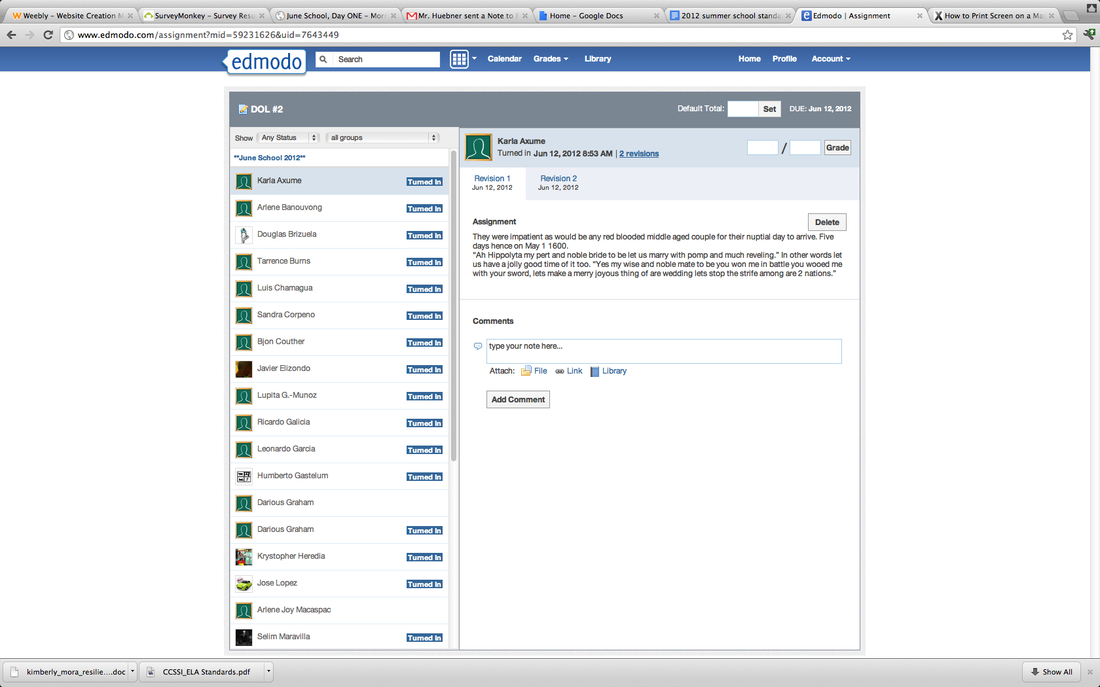
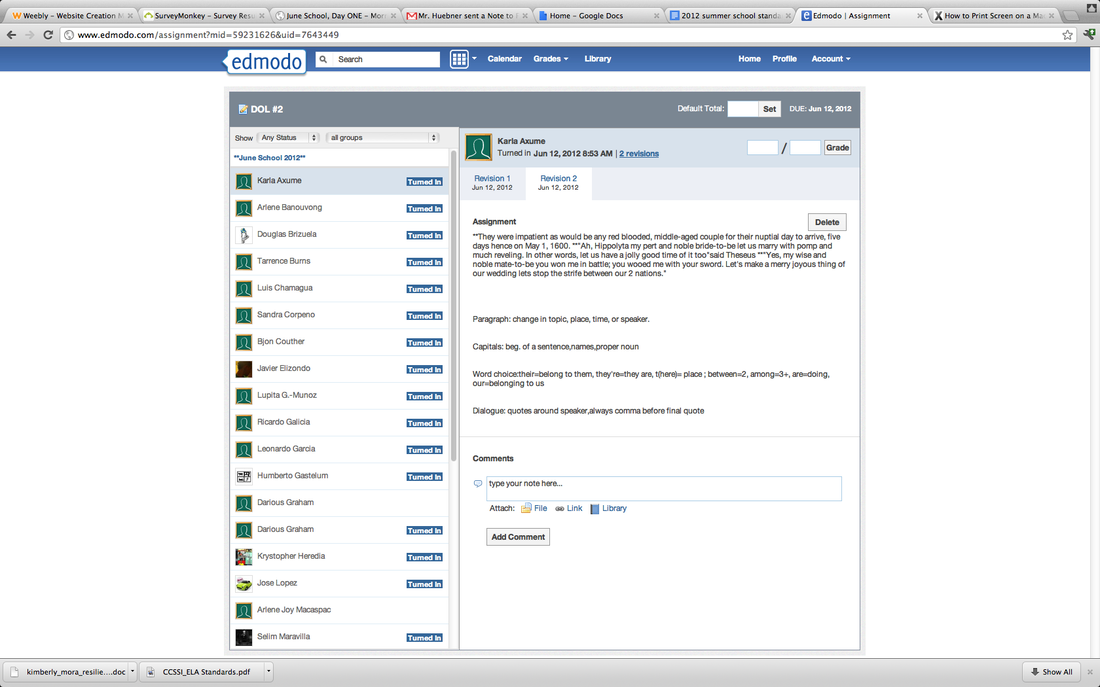
Here is a screen shot of what it looks like (the first one is the one the student did on her own, and the second is the one with our notes/corrections together):
Picture
Picture
A Google A Day
In our #flipclass chat a few weeks ago, we talked about teaching students tech skills, but particularly research skills.  I was pretty intimidated by this, because I've never taught kids how to Google.  I just assumed they knew how...until I saw them do it.  

Yeah, they need help.  Desperately.  That's were Google a Day comes in.  Every day they get a new question that requires careful googling to find the answer.  I will post a tip each day (explaining how to use phrases in quotation marks, using google as a calculator, dictionary, or translater, using +/- in searches, etc.) and then they play.  Sadly, the school network blocks Google+ so kids just have to play the "regular" game and write down their time and their answer.  

The kids really enjoy it and I've seen them use some of the advanced search tools I've taught them already.

I'm still working on the next steps for these skills.  If you have ideas or lessons, let me know!


RSS vs. SSR
I stole the idea of using RSS feeds for SSR from The Tech Classroom (the blogger is another English flipper...a rare breed of English teacher!)  She wrote about the idea a few months ago, and I thought it wouldn't work for my kids.  Until I figured out that we could use Google Reader instead of an app (Pulse) for kids without smartphones (because strangely, unlike my regular-year classes, my students right now don't all have smartphones).

Setting up the Google Reader was easier than I expected.  I set two requirements: 
1. They needed at least one news site (I recommended BBCNews or CNN)
2. They needed at least one science or technology site (I recommended Wired, National Geographic, or KQED's science/technology pages)

No one pushed back at all to those requirements.  And just to make sure they got how to do it, I left my RSS feed on the screen so they could see how I used it during reading time.  I, of course, added I Can Has Cheezeburger? to mine, and when I heard them laughing a little, coinciding with when my scrolling revealed a new LOLCat, I reminded them that they could add anything they wanted to their feeds.  

They LOVE RSS time.  It was by far the biggest vote getter in the week one survey question "What is your favourite daily activity from class?"  Here are some of their responses:

"rss is my favorite because we get to have a quiet time to read what we want"

"Rss is my favorite because I usually read news and updates on what is going on today, or at the moment in our society and i feel well informed."

"RSS because I like to read about what's going on in the world"

"I like RSS because I actually read and it was things that I WANTED TO READ not what someone told me to read. And I was able to read things I found interesting."

and my favourite response:
"RSS is the best because I get to see what kind of new news is going on the world...like the article I read today on Pulse that Titan might have life."

How cool is that?  On top of loving RSS, they were so excited about what they had read six hours before that they had to put it in their answer!  Love it.

Need more proof that they love it?  Here's a video I took yesterday during RSS time.
Flex Time
When I started writing this post, the school day was "over," but I still had one student working long after the bell announced the end of the week at 2:10.  What could have possessed a 17 year old boy to stay an hour and a half after summer school was over for the week to read a few articles and write summaries of them?  It was the flex time system I talked about a little in my last post.

Want to see the best visual proof you can get for the efficacy of using Flex Time?  School starts at 8:20.  These videos tell a pretty amazing story.
The details of the Flex Time system:
1. When students come in, I record their time on a Google Doc.  I also record when they go to lunch, come back from lunch, and leave for the day.  

2. My IWE adds up the minutes they've earned every day, and I pass those along by posting a list on Edmodo twice a week.  In the Exit Tickets they do on those days, I ask them to tell me their plan so I know they're thinking about it.

3. If they want to come in early or stay late, I ask them to request that a day in advance so I can plan for it.  The really crazy part is that there are always five or six kids who are standing outside my room waiting for me when I get there at 7:30.  We "start" at 8:20.

4. If they decide to work through their breaks or lunch, they have to be on-task, just as they would be normally.  If it veers into socialising, I give them one warning, and then move them away from each other.  I've only had to move one student on one day.  The next day, he moved back and was fine.

5. They get two 10-minute breaks during the day.  If they don't take them, they can "bank" the minutes.  It's so awesome for this main reason: I don't have to write passes.  If they need to use the restroom, get water, take a call, change clothes, get some food, or whatever, they just tell me that they're taking their break.  Because they are self-paced, they can choose the time that works best for them in their workflow.  And honestly, only about half of my students have ever taken even a single break this week.

6. When they've earned their credit hours, they are done with the course.  The only caveat is that they have to have mastered their final assessments before they are done.  I have kids who have banked a full day's worth of minutes already because they have soccer practice, a doctor's appointment, or a family obligation at some point this summer and they're already planning for it.


*******


Still reading?  I think that's it.  If you have questions, let me know!  Thanks for reading.  It's crazy that even though I am properly exhausted (for issues unrelated to teaching or school), I am still super excited about teaching.  And I can't WAIT to get back to work in August.

The even better news is that my current school offered me all the sections of Green English 11 there are.  That means that I'd get to keep my students from this past year.  I won't have to teach them how to do Flipped Class...they already know.  They have Edmodo.  They have Twitter.  They get me.  They like me.  I like them.

Pretty freaking awesome.  This could take flipping to the next level for me.  It's new content for me, but I'll also have an English 10 so I can perfect that curriculum over another year.

There is so much to be excited about....including the fact that my school is paying for my virtual registration for FlipCon12, AND paying me to "attend" with a few of my favourite colleagues.  And they're buying us copies of Flip Your Class too.  

School just doesn't get much better than that.
21 Comments

June School, Day ONE

6/11/2012

2 Comments

 
Well, day one is over.  I learned a lot about Flipped Classrooms today.  Here are a few:
1. Kids take to the flip much more easily when you start with it.
2. Teaching tech skills up front make a huge difference.
3. True self-pacing is really cool.  Some kids finished three assignments, some finished seven.
4. In-class feedback and giving differentiated lessons ad hoc is really fun, and caused a lot of important skill building
5. I didn't plan enough for my top students.  And I didn't plan for how low my low students are.
6. I really prefer the Flipped Classroom model to traditional.  
7. Instead of counting tardies/absences, I gave them a simple system: you need 20 hours each week.  When you've reached 20 hours, so long as you've worked consistently and followed my directions, you're done.  It was amazing how much more responsible they became when they had control.
8. Self-pacing makes for far fewer complaints than usual in summer school.


I decided to make the theme of summer school Resilience, to carry through the project we were doing at the end of the year.  So the first unit will be all of us doing all the assignments.  I'm also aiming towards the common core standards here - everything we do is aligned with the CCS, but also with the assessments that are coming down the pipe.  So here are the first assignments in the skill sequence (there were other assignments about mechanics, grammar, and getting to know them):


1. Essay on resilience including research on people who show resilient (Write to examine and convey complex ideas through selection, organisation and analysis of content; conduct short research project to answer a question or solve a problem)

2. Reading on resilience (Determine central idea of a text and analyse its development over the course of the text)

3. Reading from Holocaust survivor's narrative (Determine an author's point of view or purpose in a text and analyse how an author uses rhetoric to advance that point of view or purpose)

4. Re-writing that narrative from another perspective (Write narratives to develop real or imagined experiences or events using effective technique, well-chosen details, and well-structured event sequences)

5. Revising narrative after getting feedback (Use technology to produce, publish, and update writing products)

Now I need to figure out what to do next.  :-)  With those skills in focus, I think I know the general direction at least.
2 Comments

The Basics of My Flipped Classroom

5/22/2012

4 Comments

 
One of the primary things I took away from this week's #flipclass chat was that I needed to be more explicit about how my classroom looks so that other English flippers can both learn/steal from me AND so I can get feedback to make it better!

To start class, we do one of the following:
1. A DOL from The Chortling Bard - Caught'ya! Grammar With a Giggle for High School.  In my 10th grade class, we're using the storyline of Twelfth Night.  In my 10th grade support class, we're using Much Ado About Nothing.  It breaks up the story into daily sentence corrections with etymology and vocabulary development built in.  I post it as an assignment on Edmodo, then they get three minutes to correct it on their own.  I random call or take volunteers to correct it, then they turn it in.  To grade it, I choose one/two focus points and if they got those right, they get credit.  If not, they get reduced credit.

2. A review of what we did in a previous lesson.  Today, I posted a timeline activity students completed in class or at home yesterday and they went through and reviewed the work of their peers.  It helped them all review the book we're reading (Night, by Elie Wiesel) and gave me a good indication of who had mastered the material and who hadn't.

After that activity, I usually assign the main work for the day or have them continue where they left off the previous day.  I am moving from a VERY traditional method of assigning points and grading to a mastery approach, so this is a work in progress. 

I'll use today as an example.  There were two tasks that they were working on:

For students who were ready, they had their first attempt at the Reading Comprehension Mastery Test for Night.  There were 29 multiple choice and 2 short answer questions, of which most were questions developed by my collaborative grade-level team and are used by all the 10th grade teachers.  I added a few more to make sure that I could show mastery in each area.  If they passed, they obtained mastery and moved on to the next activity. 

The students who were not ready, either reviewed some of our previous assignments, or started the short story they are writing in conjunction with Davidson High School in Australia.  The story is about resilience, and they have a pre-writing task to complete.  Some did it on computer, some did it on paper (there are so many non-functional computers that we're short about 3 of a full class set in my largest section).

Tomorrow, the students will either take the test or work on their short story.  They will be writing it on computer, and submitting it on Edmodo.  Then we'll be swapping with the Davidson students, and they will be doing some peer-editing and reviewing with us.

At the end of class, I'll often have a final task that they complete to show me what they've accomplished or learned.  If we're using TodaysMeet, I'll ask it there and they'll answer it there.  If not, it will be on Edmodo, posted as a note.
___________


Now, when we're reading the novel or watching a movie, class is a little different.  For both occasions, I create a room through TodaysMeet (TM) and they all sign in.  Then they post questions, comments, reflections, etc. live as we read or watch.  I will also ask them questions and have them respond in the thread.

For essay preparation, I have them find quotes that match a theme and post it to a specific TM room dedicated to that theme.  Same with finding literary devices.  Those were the two focus themes for this unit.

____________

Now about the mastery grading.  I'm still working this out, so if I get something wrong, let me know.

There are certain skills for each unit that they need to master.  For this one: identifying and explaining significance of literary devices, finding evidence to fit a theme, understanding historical context/importance of Night/Holocaust, writing an interpretive essay, writing a short story that shows a particular theme (resilience), and writing an essay that uses a properly developed thesis, supporting evidence, compelling commentary, and correct conventions of grammar/spelling/etc. 

For each skill, there is an assessment task and several formative assignments.  They complete a diagnostic assessment, which tells me what they need to learn.   Then they complete activities that help them develop their skills.  Then they take the mastery test, and if they don't achieve mastery, they go back and review, then try again.

I'll write in my next post an example of what that actually looks like for a single strand.

Hope that's helpful for some of you!
4 Comments

First Attempt

4/30/2012

2 Comments

 
So this is my new blog!

After seeing so many educators on Edmodo blogging about their experiences flipping, I decided that they weren't doing anything I couldn't do!  So this is my attempt to record many of the successes and failures I'm experiencing in my classroom this year as a part of my experiment in flipped learning.

For a little context: I have mixed-ability 10th graders in an urban school in San Lorenzo, California (the Bay Area...by Oakland).  My classes are in themed academies, and I teach two sections in the Green Academy, and one in Bay Area Digital Arts.  The demographics of my classes are reflective of the demographics of the school and district - about half Hispanic/Latino, one-forth African-American, and one-forth white/Pacific Islander. 

Here's how it looks in my class right now:
1. For some units, videos have been more prominent than in other units.  When we were prepping for the California High School Exit Exam, we used lots of videos in a more traditional "flipped" model.   I also used them for when I had to attend a multi-day training so the kids wouldn't lose instructional time.  The videos were very skill focused - how to write a business letter, common literary devices, finding main idea, etc.  Students reported that they liked the videos, and that they preferred learning that way.  Hell, there was even a day where I lost my voice, so I showed them a video during class, and they actually paid more attention to the screen than they would have to me normally.  Weird.

2. About a month ago, we went 100% digital and paperless.  All of my assignments are posted through Edmodo, and students complete them there. 

3. The biggest change came when I hit on the idea to do Live Response.  I was watching Britain's Got Talent (I'm a British TV junkie, I'll admit it!), and they kept posting hashtags so people could use twitter to discuss what was happening at that minute on the show.  It occurred to me that it is exactly THAT world in which my students live. 

So I tried it.  I set them all up on Edmodo with a discussion thread and turned them loose while we watched a video (Dave and Trey Go to Africa - about the impact music has on culture).  It was a success - far beyond what I had even anticipated.  So much so, that I decided to adapt it for reading Elie Weisel's memoir, Night.  So they have a kindle edition of the book on their screen (no more, "Can I get my book? I forgot it in my locker!"), and they have either Edmodo, Today's Meet, or Cover It Live open on their browser (I use them for different reasons because they all have strengths and weaknesses as formats). 

As they have questions, comments, reflections, connections, or responses to other students, they post.  Instantly, I'm able to respond and clarify, or direct them to have conversations with each other.  I KNOW they understand, because I can see it clearly.  I know they are paying attention.  I know they are listening.  It's really a beautiful thing.

4. I'm working towards a flipped mastery model.  During the Night unit, I gave students diagnostic tests in the four areas in which they would be tested at the end of the unit.  From those results, students will be placed at a certain point in each skill, and will work from there.  The ones who are already advanced won't have to repeat what they already know.  The ones who struggle will get to have the time they need to master one skill before moving on.

Flipping my class has changed everything.  Even though I'm in my 8th year of classroom teaching, I feel like I'm starting over and learning so much about how to do what I do better.  It's exciting.  I haven't been so excited about coming to work in a long time. :-)
2 Comments
Forward>>

    Author

    I'm a math teacher masquerading as an English teacher. I write about my classroom, technology, and life. I write in British English from the Charlotte, NC area.

    Picture

    RSS Feed

    Follow Me On Twitter!

    Tweets by @guster4lovers

    Archives

    August 2023
    October 2017
    January 2017
    November 2016
    May 2016
    April 2016
    December 2015
    November 2015
    October 2015
    August 2015
    July 2015
    June 2015
    May 2015
    April 2015
    March 2015
    February 2015
    January 2015
    October 2014
    September 2014
    August 2014
    July 2014
    April 2014
    March 2014
    December 2013
    November 2013
    October 2013
    September 2013
    August 2013
    July 2013
    June 2013
    April 2013
    February 2013
    January 2013
    December 2012
    November 2012
    October 2012
    September 2012
    August 2012
    July 2012
    June 2012
    May 2012
    April 2012

    Categories

    All
    American Literature
    Andrew Thomasson
    Background
    Blank White Page
    Cheesebucket Posse
    Coflip
    Collaboration
    Common Core Standards
    Creativity
    Crystal Kirch
    Curriculum
    Editing In Camtasia
    Essay Exposition Class
    Explore Flip Apply
    Explore-flip-apply
    First Week Of School
    #Flipclass
    Flipcon13
    Flipping
    Genius Hour
    Grading
    Humanities
    Ion Lucidity
    June School
    Karl Lindgren Streicher
    Kqed Do Now
    Language Of Humour
    Literature
    Live Response
    Mastery
    Metafilter
    Nerdfighteria
    Ninja News
    Patterning
    Procrastination
    Professional Development
    Puppets
    Reading Journal Videos
    Reflection
    Resiliency Project
    Sam Patterson
    San Francisco Stories
    Showme
    Spring Semester 13
    Student Post
    Success
    Technology
    Tfios
    The Beginning
    The Mess
    @thomasson_engl
    Tired
    Today
    Today's Meet
    Troy Cockrum
    Twitter
    Ubuntu
    Video
    White Blank Page Project
    Why We Read
    Youtube

    RSS Feed

Powered by Create your own unique website with customizable templates.