TMI Flips English
  • Welcome!
  • Blog
  • Thomasson Morris Instruction
  • About Me
  • Contact Me

Flipped English Summit Conversation

1/9/2013

2 Comments

 
There are some days where you just don't feel quite so alone - that was today.  

For most of my colleagues, the first day back to class meant hiding out, staying isolated all day, learning new names, handing out syllabi, just surviving.

And even though I had five brand new classes that started today, it was a day of really meaningful connection.  I intentionally got out of my classroom to talk to a few colleagues and had some great (short) conversations with them.  

I also got to speak to every one of my new students (all 152 of them!) at least twice, and often five to six times in the class period.  I don't know their names yet, but I have seating charts with preferred names filled out and group pictures so I can try to learn them faster than last semester (I'm pretty sure I was still guessing on names in the 6th week...remembering that many new names in 50 minute periods just doesn't work for me I guess).  I ha former students drop in to say hi.  The best ones were when 6th period was about to start, and a whole group of my former 6th period students walked by - they wouldn't stop telling the newbies how lucky they were, and how they wished they could switch with them.

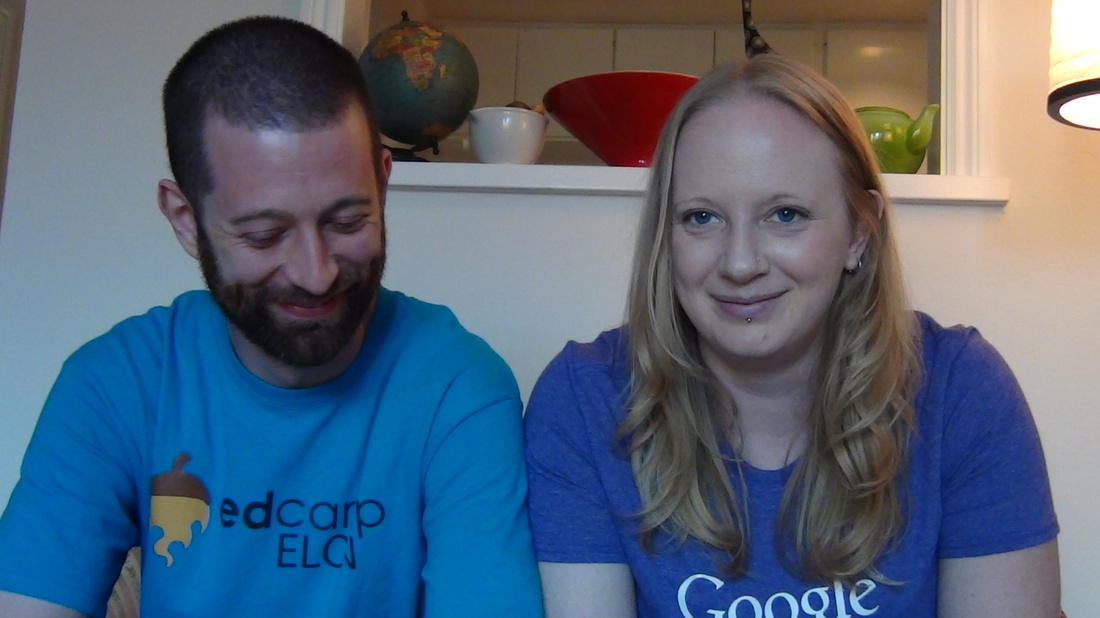
But the amazing thing was tonight.  For about 90 minutes, Andrew and I had the pleasure of being a part of the largest gathering of English flipped learning teachers that we know about.  Here's the line-up:
  • Me, 11-12th grade, California
  • Andrew Thomasson, 10th grade, North Carolina
  • April Gudenrath, 9-12 IB, Colorado
  • Kate Baker, 9th/12th grade, New Jersey
  • Katie Regan, 10th grade, New York
  • Shari Sloane, Alternative school environment, New York
  • Sam Patterson, 9th grade, California
  • Dave Constant, HS, Connecticut 
  • Troy Cockrum, 7th-8th, Indiana


The amount of knowledge in that room is just absolutely incredible.  I learned so much just from being there and listening.  It reminds me of just how much we really need each other and how important it is to work with each other, but also just to connect and be friends.  We need both.

The most amazing thing is that all this time, there has been another collaborative partnership - Katie and Shari - in the English Flipped world.  It seems that Katie and I play a similar role, and Andrew and Shari play a similar role in the way we work together.  

As Andrew and I debriefed the conversation, we were struck by just how much we know, but how much we don't know.  None of our flipped classes look the same.  We all flip writing to some degree, but it looks different in every context, every classroom, every video.  Reading is a much more open field with far fewer answers.

We recorded the conversation and will be posting it soon.  I hope more people can learn with us.  As Andrew says, we may know stuff and may be "defacto experts" but we are learning as we go.  

If you're interested in joining us for one of these conversations, let us know either here on the blog or by finding us on twitter.  Maybe we can fill the room a little bit more next time.
2 Comments

So...are we flipped, or aren't we?

12/10/2012

1 Comment

 
A lot of people, much smarter than I am, have been writing what it means to be flipped, and some other people (also smarter than me) have questioned whether or not what we're doing can even be called flipped.

Naming something, defining it, is a way of understanding.  We give things names so we can catagorise, analyse, interpret.  It's natural, and it's helpful.  

But what happens when something changes, expands, grows, and the definition no longer is quite right?  Do we come up with a new term?  Do we become more strict with the definition so as to be more clear?  

Or do we expand that term so that, rather than constricting our understanding, it widens it and allows for more people to come inside and be included.

That, more than anything, defines flipped learning for me: inclusive.

When I happened upon flipped learning at this time last year, I didn't see how I could fit in.  My students were poor, they lacked internet at home, and I had no way of recording video.  Oh yeah, and all the models out there were for math and science, and I taught English.

But there was something about flipped learning that caught my attention.  In a school where direct instruction was mandated and commonplace - almost part of the DNA - it seemed like something that would both please my administrators AND help my students learn.  I could do direct instruction but I could also spend more time helping my students get better at reading, writing, listening and speaking.

It seemed like the perfect solution in many ways.  

So I went looking for a way to make it work.  My district Ed Tech director got me an iPad so I could make my own videos.  I polled my students, and only three of them didn't have a smartphone or a computer with internet access at home (this was in a 90% SED school).  I arranged for those three students to use my devices during break, lunch or before/after school.  So I made some videos with the week's etymology lesson, assigned them as homework, and used the time we would have spent copying the notes practicing with the content, doing real-life examples, and playing memory games.  Test scores on the weekly quizzes went up, and I was confident I was on to something.

Then that same Ed Tech director pitched Twitter to us.  And I was Not Interested.  At all.

For a few days.  Finally, I just asked my students to teach me Twitter and help me get started.  They were happy to oblige.

Very quickly, I was hooked.  And that's also when I discovered that there was so much more to flipped learning than I had ever expected.  

I joined the #flipclass Monday chats (which now I help moderate semi-regularly).

I started blogging and sharing my posts on Twitter (which may be where you found this post).

I had conversations with some of the people I had read about - Brian Bennett, Crystal Kirch, Troy Cockrum, Jon Bergmann, Aaron Sams - and they all helped to push my thinking on various issues.  Many have now become my close friends.

That's how, within six weeks of flipping, I transitioned from "Flip 101" (assigning videos as HW and former homework as classwork) to something that I still saw as flipped, but wasn't the same as how many of my colleagues flipped their class.

My classroom quickly became mastery-based, paperless, self-paced and homework free.  I still made videos, I still used many of the same tools as my Flip 101 colleagues...

...and I still tweeted to the same hashtag.

Flipping my class no longer was my goal.  I was flipped.  Instead, my goal was to make my flipped class the best possible place for MY students, in MY context.  I started to view flipped learning as a place where students had ownership (responsibility was flipped to them from me) and where I used technology to help them learn best.   Later, I moved to defining flipped learning by the Flipped Mindset - a definition developed by several collaborators on Twitter.

Now, a year into my flipped journey, my classroom looks different than it did last fall, last spring, or even at the beginning of this school year.  

I have what I like to call my CoLab partner, Andrew Thomasson.  He helps me plan all of my instruction, prepares for and films video lessons with me, and encourages me to be a reflective practitioner, a good flipped teacher, and a better friend.  I'm at a new school and operate with a BYOD policy and open wifi network.  My students are much higher skilled, and require far less direct instruction (almost none).  I don't assign homework, and don't always use video.  I've stepped away from self-pacing and paperless (without 1:1 netbooks, that's a lot harder) and embraced a far more student-centred pedagogy that focuses on higher-order thinking skills and real-life application of concepts.

There are many people who would say I'm not flipped.

And I would argue, just as vehemently, that I am.

**

When Romeo asked himself, "what's in a name?" I doubt he was thinking about its application to the flipped class community.  Nevertheless, it's a good question.

So, flipped class community, what's in a name?

For me, this is what's in a name:
  • a method by which I started to listen more to my students, and work to meet their individual needs.  I learned most of those things from my community on Twitter and Edmodo.
  • a move to a more reflective practice - one I never imagined.  I didn't know that to be reflective, you need someone who will help you process.  That is what happens in the flipclass community on a daily basis.
  • a return to my writing - something I had always thought of, but never had inspiration to sustain.  This blog is the most meaningful writing I've done since I graduated from college.  And I am now writing more than just blog entries, which has helped me work through a lot, personally and professionally.
  • a transformational experience - one that not only changed me, but changed how my students experience me as their teacher.  That was only possible by moving over the bridge that flipclass built.
  • a group of people - my Cheesebuckets - who listen to me, protect me, question me, challenge me, and keep insisting that I should not stay where I am, but keep moving forward, getting better.  These people would not be in my life without flipclass.  And my life would be far less rich without them.
  • and most importantly: a collaborative partner, a new BFF, someone to listen to me, help me channel my crazy ideas (and sometimes, add more craziness until they actually start to make sense), doesn't let me stay frustrated or resentful, but insists that we work things out, and most importantly, someone I can trust and who I know cares about me, both as a teacher and as a person, and about my work in the classroom.

So what's in a name?  A change that has given my students a better teacher and a better education.  A community where I am inspired, engaged in conversation, and often, challenged so that I don't grow stagnant.  

And most importantly, I now have friends.  Friends who share the family name - flipped class - and unites us around a common goal: making our classroom the best possible place for our individual and corporate student body, and for us as teachers.  

And even though some of us may start to grow into more distant cousins, if we give up the family name, it would mean denying where we came from.  This is the kind of family that doesn't disown a brother who shies away from family gatherings; it's the kind of family that expands, becomes more inclusive as more and more distant relations show up on our doorstep, needing our help, our acceptance, our love.  It's also the kind of family that still welcomes you, even when you don't need it anymore.

This family name is where our roots are.  

This family name is who our people are.  

This family name - flipped class - is who WE are.  Together.

That is what's in THIS name.  

And I'm proud to be in this family.  No Matter What.
1 Comment

Explore-Flip-Apply: Student Edition

12/10/2012

0 Comments

 
I've written about my 6th period class a bit in previous posts.  They've been doing projects on an area of humour that we have not studied together.  

Today, we had a study in contrasts.

The first group started presenting on Friday, but because of some administrative tasks, they weren't able to finish.  Their presentation was about stand-up comedy.  More on them in a minute.

The second presentation group covered ten types of humour, with some examples.  Here is what they did (see if you recognise it):

1. Gave a handout with ten definitions of types of humour (slapstick, parody, satire, etc.).
  
2. Read the definitions off the PowerPoint (exact replica of the handouts).  Around the third slide, they lost the audience.  When the audience started to recognise that the presenters did not fully understand everything they were teaching, the audience responded by asking questions.  It started with factual questions - does that include x? What does y mean? - and progressed to more chatter than actual questions.  The audience actually seemed frustrated to not be learning and resentful of the waste of their class time.

3. At this point, the group rushed through the last few slides so they could get to the videos.  They hadn't made them hyperlinks, so they had to manually copy/paste them into another browser window.  Several members of the audience shouted at them to do control-click.  They either didn't hear or chose not to listen.

4. When they finally had the video ready, they didn't give context.  Just pressed play.

5. Less than half of the audience was paying attention.  They continued regardless.

6. After the first clip, they asked students to write their answer to the comprehension question on the back of the handout.  They had only made enough for each group to have one.  So they told the students to do it as a group.

7. Then they showed a second clip and gave them a second comprehension question.  

8. As class was about to end, they just went back to their seats and told students to "turn in the papers or something."

Is it their fault that their presentation wasn't effective in teaching the students, or engaging their attention?  Not necessarily.  They haven't been trained in how to present information, and have been less than attentive for much of the semester.  

Their presentation was the first one from that class that was anything less than mind-blowing (like producing a comedy video, leading an improv workshop, analysing memes about Marin...all fantastic and very funny).  For a student presentation, it certainly wasn't bad.  Yes, they committed some presentation sins (technical problems, reading off the PowerPoint, not being fully prepared, not keeping the audience engaged, etc.) but they met the requirements set out in the assignment.  They are decent students who are just not terribly engaged in school, and despite having the freedom to choose an elective, ended up in one they enjoyed but didn't really connect to.

**

It had been so different with the first group.  When they finished, I was astonished to realise that they hadn't just learned the tools of humour analysis.

They had learned effective lesson structure.

They had unknowingly used Explore Flip Apply - the same structure I have used to teach them all semester.

I didn't tell them my structure, and so certainly never encouraged them to follow it.

But here's the lesson they presented:

Explore:
Students were directed to a bitly address that took them to a collaborative google doc.  The presentation group asked them to write a joke - any joke.  It didn't even have to be funny.  They watched and laughed as their classmates entered jokes anonymously (since it was a public link, they didn't need to sign in....an intentional move by the group to let people have the freedom to be experimental).

Flip:
The group then presented a few techniques used by stand-up comedians, such as timing, exaggeration, and exploration of the unexpected.  They solicited feedback from the audience to clarify their misconceptions, and posed a few questions to check their understanding.  They showed several clips (since they ran out of time, they assigned one as homework - the "Hot Pockets" Jim Gaffigan routine - best. homework. ever.) and asked the students to identify some of the elements used, as well as analyse their effectiveness as humour tools.

Apply:
Finally, they had students go back to the google doc and look at their own joke again.  They asked them to revise their joke to add some of the elements.  Then they asked students to come up to the front and tell their joke as a stand-up routine, and then asked the audience to analyse the techniques used.  Four students volunteered and shared, and several more would have shared had there been time.

Finally, we did our Seminar Assessment reflection questions (which they had helpfully included in their presentation, even without it being required), where the group listened to the feedback respectfully.  They even offered some additional materials to let advanced learners find out more.

**

They Explore-Flip-Applied a presentation, on their own.  And it was as (if not more) effective than what I've taught them.

So how is it that one group was so successful, and the other group wasn't?  

Was it because of the strength of the relationship built with their classmates through discussions, seminars, and collaborative group work?  Sure.  The second group spent more time checking Facebook on their phone than participating in class.

Was it having clear passion for the subject and an intense desire to communicate that to their peers?  Absolutely.  The second group were far less attached to their topic than the first.

Was it having the necessary toolkit of skills?  Yes.  The second group struggles to think critically and write effectively.

Or was it because the first group took responsibility for their learning, and had ownership, and the second group didn't?

I think that's the key point.  All of the other things were essential to getting them there - relationships, passion, skills - but when they took ownership and had pride in their work, they naturally gravitated to the instructional technique they had learned first-hand from me.  And while the second group learned something, it was the first group that had really been transformed.

This presentation wasn't just something they did.  It became who they are.

And they don't need a grade to prove they learned something.

Nor do I need a test to prove that I taught something.

And now that I have a fresh start coming in a few weeks, I'm afraid that I won't be able to repeat this kind of awesomeness.  It's daunting to see the final product and think about starting over.

But maybe next semester, there won't be a second group.
0 Comments

Our First Flipped Unit...For You!

9/26/2012

2 Comments

 
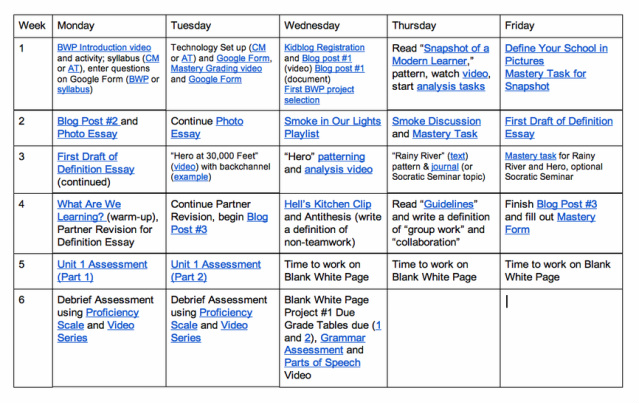
Andrew and I have worked incredibly hard this year to make our team-teaching a success.  We spend hours planning over G+ Hangout, or in Google Drive documents, and we are pretty proud of what we've accomplished.  None of the material in our first unit was anything we had ever taught (with the exception of one of the short texts each).

We also believe in open source, free materials for teachers.  We do not intend to ever sell our materials.  We want to give them away for free with the caveat that you give us credit for the work.  We, by no means, want to present the material as if we think it's perfect - it's not.  There are lots of changes we will make when we teach it next (since we both have new students at the semester, it will be January-February when we teach it again).

But for now, here is the unit - complete with planning documents and links to every assignment, text, grading rubric, and warm-up.  If something is listed but doesn't appear, let us know and we'll fix it right away!  Almost all of the links are through Mentor Mob, since that's where we store our student playlists.

I hope you find it useful.  It's been amazing to plan and teach, and we hope that others can use some of the ideas we have developed here.

Here is the information from the document linked above:


The Master List of Unit 1 Resources
Andrew Thomasson and Cheryl Morris


Planning Documents:
Original Unit Plan (with full assignment descriptions, although a bit different from what we ended up teaching)
Skills Map (Thomasson’s iteration)  
Morris’ iterations: 1 2 (Morris modified her maps from the main document)

Playlists:
Weeks 1-3 (Morris)   
Weeks 1-2 (Thomasson)    
Smoke in Our Lights (both)    
Weeks 3-6 (both)

Unit Goals:
  1. Introducing students to the technical processes they need for the class
  2. Easing them into the flipped class part - how to watch video, how asynchronous instruction works, how mastery grading works, etc.
  3. Familiarise them with the patterning strategy and why we use it
  4. Making inferences based on evidence
  5. Constructing a definition, both in narrative and informational writing
  6. Collaborate with peers on a variety of tasks, and differentiate that from doing Group Work.

Essential questions:
  • What is a flipped class, and how does OUR flipped class work?
  • What goes into a good definition, and how does that differ based on genre and purpose?
  • What is the best way to collaborate, and how is that different from cooperative learning/group work?
  • What is a pattern and how do those patterns build meaning in a text?
  • How do you access meaning beyond the literal/surface level?

Since our classes are asynchronous much of the time, this is mostly a suggested pacing, and is close to our actual pacing.  It took Morris six weeks, with about 240 minutes per week (11th-12th graders), and it took Thomasson four and a half weeks, with about 450 minutes per week (10th graders).  Please use any resources freely, so long as you give us credit for our work.
Picture
Note: the links won't work from this table because it's a picture.  Weebly strips the formatting out when I tried to copy and paste from Google Docs.  If you want to follow the links, you'll have to open this document.
2 Comments

What Technology I'll Use

8/1/2012

16 Comments

 
Yesterday during the #140edu conference, I began to think about the technology that plays a large role in my life.  Here is what I use primarily:

1. MacBook Pro, 17' with the apps I use the most: Camtasia, Adobe Photoshop Suite, Chrome, uTorrent, iTunes, and VLC

2. iPad 3 (Verizon) with ShowMe, Messaging, Mail, Twitter/HootSuite, DailyBible, Flipboard, Edmodo, Notability, Instagram, Facebook, Camera, Music and Paper 53

3. iPhone 4 with most of the same apps as the iPad, Socrative and Pandora as well.

4. Web-based apps: Google Docs (including shared folders and live collaboration with the #cheesebuckets), Dropbox, Weebly to maintain this site, BBC iPlayer through Expat Surfer, UKNova, Netflix, and Hulu Plus.

Now, why am I telling you all that?  Because I believe that it tells you something about who I am as a person, as a teacher, and as a learner.  Most of my news comes from Twitter.  All of my television/screen time is through my computer (I don't even have a TV).  All of my radio and music comes from what's stored between my three devices (and a really old iPod classic) and Pandora.  Most of the communication I have with friends is through Twitter, Facebook, and messaging. 

Even right now, I have all three devices open, working on different things (streaming the final of the men's gymnastic all-around competition on BBC and composing this on the MBP, Twitter on the iPad, messaging on the iPhone).  I take all three devices everywhere, because this is how I engage with the world. 

And I'm double the age of most of my students.  If technology is so important to me, then how much more is it to them, who have had it their entire lives?

But that's not the point of this post.  It is however, sort of relevant.

******

As I was thinking through my preferences for technology use, I suddenly realised that it wasn't MY preference that matter.

In a flipped class, student-centred pedagogy is one of the three pillars.  So why am I the one setting the requirements?

Now, there my plans/goals for my students:
1. I want all students to blog
2. I want an LMS, either Moodle or Edmodo or both
3. I want to use google docs
4. I want all students to use an RSS feed for SSR time
5. I want to use a backchannel for live response
6. I want to participate in the KQED Do Now curriculum
7. I want students to collaborate outside of class time
8. I want students to watch some videos outside of class time

And there are some things I know about my students:
1. They all have gmail and google docs and like them
2. Most don't have Twitter accounts
3. They use Moodle
4. Most have their own devices to use in class
5. They are not used to using technology in class. At all.

So there are a lot of pieces of information I don't know yet.  But here's what I do know:

I need to allow my students to drive the technology in my class.  Instead of teaching them all new tools, I need to help them gain proficiency in the ones they already have and know.  When it comes down to it, I need to embrace the mess and allow my students to teach me sometimes, rather than me having all the knowledge.  I need to use their passion for technology and show them how to make it relevant to my class.  I need to put aside my preferences and be willing to not be the expert in order to better meet their needs.

So I don't have a completed plan for what technology I will use.  And that has to be okay.  I have a starting place: Moodle, Google Docs, and a BYOD policy.  And I have lots of question marks: Will I require a Twitter account?  Will I use YouTube?  Will I use Google+ hangout?  Will I use Edmodo?

I don't know.

I DO know that I don't want to give my students a worksheet asking them what they use.  Here are some ideas for how I might gather this information:

1. Have students enter the names of their technology into a Google form (much as I did at the start of this post) and then create a Wordle from it.

2. Use the start of year video to show my technology, and have students write a blog post or create a video of their own showing theirs.  Yes, this is time consuming, but I can really learn a lot from this about my students and their context.

3. Ask students to put together a photo essay about their technology use.  Turn this into an essay.  It has nice thematic links to the Snapshot of a Modern Learner article.  It could even be part of the essay on that text.

4. As the first project in Blank White Page.  Again, the video I make could be the model for this to show them what BWP is all about. 

****

I'm sure there's a better idea out there of how to do this.  Feel free to comment and tell me your ideas for non-worksheet ways you collect this information from your students.
16 Comments

Why You Should Use Video, Part 2

7/31/2012

5 Comments

 
This is the second in a series of posts about using video in a flipped class.  To read the main article, click here.  

How many of us check Facebook, Twitter, email, the surf the internet when we get bored?  I know I've done ALL of those during PD, especially when I didn't see the relevance to my life or practice.  And yet I've had students get multiple day suspensions for doing exactly the same things.  Why? Because the rules are different for students than they are for us.

Now maybe you're more professional than I am and have never done it.  And maybe I'm of the younger generation (I'm 29) that is closer to our students than many of my colleagues, so my technology use is closer to a typical student than a typical teacher.  I've had a computer since I was two years old, and started using the internet in 7th grade.  If I want to know something, I google it.  If I want to read a new book, I buy it on Kindle.  

I have three devices going right now - MacBook Pro, where I'm watching the BBC coverage of Olympic gymnastics (thank you Expat Surfer! I hate NBC's coverage sooooo much) and typing this entry.  On my iPad next to me, I've got Twitter open, and have music on pause between events.  Then there's my iPhone, which is charging between text messages.  I nearly always have all three devices with me, so that I'm never without access to email, Twitter, Google docs, my music library, or my camera and photos.

If you asked me to go back to college and not use any of that, and not be able to Google when I wanted to know a basic fact, I would feel cut off and blind.  Hell, I need music to be productive during my work time.  If it's too quiet, I get distracted easily. 

Does that mean I'm a failure as a learner?  Does that mean that I am dependent on technology?  Does that mean I'm distracted all the time from the "actual" work?

No.  It means that in my cultural context, I see technology as integral to my life.  The devices I have give me the ability to learn anything I want to know.  On the road trip I just finished, we had regular "Why don't you Google that?" moments.  We used Maps on the iPad and Android instead of my old Garmin GPS.  We played hours of music from our combined devices.  I edited videos in Camtasia in the car, read on my Kindle, and multi-tasked between devices, all while documenting the trip so Andrew could see the West Coast and having bonding time with my road trip buddy.


Technology is simply the language I speak, and the tools I need to navigate the world around me.  I could live without technology, but I just don't see the point.

Our students have never lived in a world pre-internet, nor do they remember a time before there were smartphones.  They feel that they need technology as much as food and air.

Why would we ask them to stop using the tools that define them and that will give them the opportunity to make the learning more relevant to their lives?  Our job is to educate them, but also to engage them where they are but inspire them to be better than they are.

I am not saying that you need to go paperless and try every new tool out there.  In fact, I have decided to allow student preference to guide our technology use this year more than my preference will.  I believe that if students are allowed to use the tools they love and maybe even teach me something about them, they will engage in learning more fully and with greater passion.  And I will attempt to model that using technology is not always easy, but can make the results far more spectacular if used appropriately.

Now, I understand that many schools lack the technology to make it as integrated to their classrooms as they would like.  However, there is a test that Ramsay Musallam uses at the beginning of the year that I'm going to steal.  I will ask them how many check Facebook, Twitter or other social media every day.  If they can do that, they can watch videos or complete basic assignments using the internet.  I have very few students who have ever said no to that question.  And for those students, I've never had one who didn't have a TV and DVD player.  Maybe I will at some point.  And if I do, I will make sure that student has equitable access.  Period.  Or I'll change my expectations.

To return to the main article, click here.
5 Comments

Why You Should Use Video, Part 1

7/31/2012

3 Comments

 
This post gives one of the reasons I use video in my flipped class.  Click here to read the frame narration for some context on why I'm making this argument. 

1. Using video has brought a collaborative partner, Andrew Thomasson, who has made me a better teacher and made nearly everything you've read on this blog in the last month possible.  We will be team-teaching from across the country this year.  We will be doing most of our videos together as well.  A few people said to me that my students will know him as well as they'll know me.  I think that's awesome.  If they don't connect with me perfectly, I've given them another teacher with whom they can connect.  

There is no way I could do that in any other way.  Process videos, in my opinion, work better with two people so that the thinking is far more apparent through the conversation than it would be in a monologue.  For my students, they will get to see two "experts" try, fail, try again, fail again, and support each other.  It models many things more powerful than I've ever been able to show my students: how to work with a partner, how to revise as you go, how to explain your thinking, how to push the other person to do better, find a more precise word, and build a better paper.

If I flipped without video, none of that could happen.

But giving my students another teacher, one who complements my weak areas, one who helps to clarify my thinking, and one who makes me excited to be a teacher again.  It gives me someone to bounce ideas off on, and to push me farther than I thought I could go.  It makes me a far better teacher for my students.

And if I haven't convinced you to use video yet, click here for reason two.  And click here to go back to the main post.

And because I'm really, really proud of the work we've done, here is the playlist of all 20 videos in the (completed!) Research Paper series.
3 Comments

So you want to flip your class...

7/28/2012

1715 Comments


by Cheryl Morris, Andrew Thomasson, Karl Lindgren-Streicher, Crystal Kirch, and Kate Baker

School starts, for most of us, within four weeks.  What that means is that many teachers are starting to gear up, and have begun to plan their upcoming year.  That means lots and lots of people are discovering the flipped class model for the first time.

So there have been a lot of tweets sent to me and others in the #flipclass circles asking for information about how to flip their class.  Some of the most common questions:

1. What if I don't have the technology to use in class?
2. What if my students don't do homework?
3. What if the students haven't watched the video?
4. How can I flip if I can't make videos?
5. Am I already flipped? I do everything you describe except the video?
6. How can I make this work for me in x context or y situation?

I can't answer all of those. 

And these ideas are not mine.  They were developed in conjunction with several other teachers...the usual suspects really: Andrew Thomasson, Karl Lindgren-Streicher, Crystal Kirch, and Kate Baker.  Between the five of us, and based on conversations with and presentations from hundreds of other educators on Twitter, Edmodo, and in person or in Google+ hangout, we have developed a definition of what it means to flip your class.

So I can tell you what we've discussed, and what I've told people on Twitter:

There is no one right way to flip your class.

There is no How-To binder for sale.

There is no panel of experts to tell you what to do.


However, there is the Flipped Mindset. 

We chose to use the term Flipped Mindset intentionally - we don't want to define Flipped Class as a pedagogy or an instructional method or a theory. 

We want to define it not as something you do, but something you have. 

Within this framework, you can have thousands of different iterations that are all flipped, but are equally different.  In fact, I would argue that no two flipped classes should look the same; if we are differentiating for the kids in the room, then every classroom, and even every period, HAS to be different. 

So what makes up the Flipped Mindset? 

There are three pillars:

1. Teachers make the best use of their face-to-face time with students.

2. The classroom uses student-centred pedagogy.

3. There is an intentional focus on higher-level thinking, rather than rote memorisation.

******

What do those pillars mean?


For the first pillar, what you're really talking about is being a reflective educator who uses the tools they have available to reach their students in the most effective possible way.  For me, that means using social media and video (both collaborative with Andrew Thomasson and on ShowMe, my iPad app) because technology is the language my students speak, and I think it's important to A) teach them how to use it responsibly, and B) show them that learning can happen regardless of what tools are used.  Additionally, I think there are some really cool things that can only be done through use of technology (see: collaborative videos with someone from across the country).

However, if the use of video is what is holding you back from flipping, then hear this: IT'S NOT ALL ABOUT THE VIDEO!  What it IS all about is your students, and how you can best serve them in the time you get face-to-face in the classroom.  If something is less important, you can off-load it to out of class time.  If your students won't do homework, then make your class asynchronous or set up stations for different learning tasks.  I should clarify: this doesn't mean that there is never time given in class to students acquiring knowledge.  If that's the best use of your class time, then that's fine.  The key here is reflection and understanding of your students.

The other thing to consider is the tasks in your discipline that would be most difficult in terms of cognitive load.  Those are the tasks that would be most productive to have students engaged in while the teacher is present.  In English, those tasks are reading and writing.  Having students read in class and write in class, while they have access to their peers, who are working on the same thing, and access to their teacher, who can help when they get stuck, gives them the opportunities they need to build those skills, make mistakes, and catch those mistakes without becoming overwhelming.  Students learn to collaborate, but they also learn that even "experts" make mistakes and have to work through them.  And using the face-to-face time you have with students appropriately lets you guide them through those processes which they will find most challenging.

For the second pillar, the teacher is no longer the centre of the classroom.  The entire environment is geared towards the student not only being an active participant in the learning, but also helping to drive the learning.  While it's not possible for students to always create content or allow student choice determine what is taught, including students in the process is key.  Rather than the teacher being the one driving learning and dragging the students along, the students are collaborative.  Rather than being competitive with each other, students share their understanding, which leads to a deeper comprehension and increased ability to make meaning from it.

When Andrew and I started making our collaborative videos, we began at the same point that most other Flipped Class educators do: with content videos.  We wanted to make videos that would allow our students to learn the information they needed to write a research paper.  However, we quickly found that what we were teaching was not content, but rather process.  We were showing students the steps and content of what goes into an essay, but we were also showing them what it looked like to compose that essay, with all the mess and all the problems, and all the real things that happened. 

We went from being teachers with all the answers to students who were actually learning from each other, collaborating with each other, and composing an essay that was far better as a result than one we could have written alone.  That element is key in the shift we made to a more student-centred approach to video in our flipped classes.  It also pushed us to go even farther than that, and develop something we're calling the MetaFlip, or making the process we go through when we read, talk, write or think visible and transparent to students.  It takes us one more step off the stage, and shows students that we make mistakes, that we have to work to understand material, and that collaboration is the key to all the good ideas we ever have.  We'll talk more about MetaFlip later.

The third pillar, engaging in higher-order thinking, is based on Bloom's Taxonomy.  At the top of the pyramid are the higher-order thinking tasks: application, synthesis, analysis, and evaluation.  At the bottom are the rote tasks of comprehension and knowledge.  A class using the Flipped Mindset does deal with facts and basic information, but the priority is taking those facts and working with them, transforming them, and making meaning out of them. 

********

Those three pillars are the three things you need to flip your class.  And guess what: YOU DON'T NEED VIDEO!  And guess what: YOU DON'T NEED TO HAVE STUDENTS DO HOMEWORK!

If you really want to know whether your class is flipped, ask yourself these questions:

1. Do I intentionally plan my face-to-face time in order to allow for the tasks that require the highest cognitive load?  Do I use that information to guide my students as they learn the content and processes?

2. Are students at the centre of my classroom?  Am I in a "guide" role, rather than a "sage on the stage" role?  Am I emphasising collaboration over competition?  Can students see me as a learner, including when I make mistakes?

3. In the assignments I create and assessments I give, is the emphasis on knowledge that is not "google-able"?  Am I asking students to analyse, apply, synthesise, evaluate, and create, rather than just know and understand?

If those questions can be answered yes, you have the Flipped Mindset.  You HAVE flipped your class!

That being said, while I believe that using technology is essential for ANY modern educator, the three things that define what it means to flip your class do not have to include technology.  There is no reason that equity, technology access (or lack thereof), or teacher familiarity and skill with technology have to be barriers to flipping your class.

I know that most of the ideas that build the three pillars returns to the constructivist pedagogy of the past.  And that's why I believe that using technology is important for all teachers.  Students "live" in the world of technology, and if we speak their language, we can help them transfer all the skills they use every day and make them work for their education as well. 

When you have the Flipped Mindset AND you embrace the technology you have available to you, your students will only benefit.  But flipping isn't and shouldn't be synonymous with video.

******

Wow.  That's a lot.

You can read Andrew's post on this subject here.  We will be making a video about this soon, because I think talking about it on screen, with multiple educators, using real examples of how it looks in their class, makes this subject much more clear and comprehensible.  We also will be covering the tools in the toolkit for each discipline and how those apply to our flipped classes.

I know that there is a lot of work to be done before the start of school in a month.  But it's exciting work - and it has helped me become a far better teacher than I was before I flipped my class.  I flipped in the middle of the year.  I wish I had started over the summer, preparing and getting things ready so that those first few months weren't so chaotic.  So if you're looking at this and wondering where to start, find us on Twitter!  Leave a comment!  Get in touch in some way.  There are loads of us willing to help you get started, because there were people before us who helped us get started, and you will in turn help others when you've on your way.  The collaboration I've found through the #flipclass community is amazing, and I am blessed to count my co-authors/originators on this post not only as collaborators, but as friends.

*****

Thanks to Jon Bergmann for the shout out/Friday Follow in this tweet a few days ago:

#FF to great #flipclass #elachat folks. @thomasson_engl @guster4lovers #edchat

— Jonathan Bergmann (@jonbergmann) July 27, 2012
1715 Comments

It's Almost August - Updates

7/26/2012

1 Comment

 
There are exciting things happening.  And not just on my vacation.  But I'll start with those:

1. I got to meet Karl Lindgren-Streicher!  In person!  In Seattle!  Not just on Google+ hangout!  We spent a fun day talking Flipped Class and General Life Topics of Interest.  I also got sunburned...at a beach...in Seattle.  Will wonders never cease?  And since Karl and I live, like, fifteen minutes from each other, we will certainly be doing that again....although next time, probably closer to home.

2. Andrew and I have some big, big ideas to debut soon.  None are really ready for Prime Time, but the afternoon I spent with Karl yielded some amazing things when Andrew and I debriefed.  Yes, this is totally vague and general.  But you'll all know soon enough!

3. Blank White Page has gone meta.  I'll talk more about this as we get the site built, but Andrew, Karl and I have been working on our VERY OWN BWP project.  Since Andrew has never been to the Pacific Northwest, we were talking about what the armpit of California looked like (the answer? Corning).  Then we realised that instead of describing it, I could just start texting him pictures along the way - the BWP question was "What is the West Coast of America like?  How have those places shaped who you are?".  And thus was a BWP Satellite project born.  So when I met Karl in Seattle, he gladly offered to join the cause of "Show Andrew the West Coast" and the project went from "fun distraction" to "a whole new level of awesome."  We will be cataloging and posting this project when both Karl and I get home.

4. With Andrew's encouragement, I've started writing some creative non-fiction.  It has been really rewarding and I want to (again, as always) publicly thank him for not only encouraging me, but making the first draft of what I wrote readable to someone who is not in my head.  Writing is something I gave up on years ago, and it's been fun to remember all the reasons why I loved writing so much.

Here are some NON-vacation updates:

1. The Research Paper Writing series is pretty much done!  I'm still editing the final conclusion videos (and I'm half done!), but all the prewriting, drafting, and introduction videos are posted to our YouTube channel.  We think they started getting better around video 4, but we're proud of the progress we've made.

2. Next on the agenda is the first in our flipped reading strategy collaborative video.  We will introduce a writing strategy and then walk through a text and a literary analysis essay.  That series will start soon...as soon as we can get a functional wifi connection and some time.

3. We have posted another Conversations in Flipped English video on YouTube.  This time, it's about keeping the humanity in flipped English class.  The first in the series is found here (on Content vs. Process flipped videos).  We hope you find them helpful!  Here is our ENTIRE Flipped Professional Development archive as well.

4. As we finalise our plans, we will be posting the first unit plan Andrew and I plan to teach (that we wrote together).  It covers the basics on technology, what a flipped class is (for students/parents), reading and writing basics, blogging, working in a collaborative group, using peer feedback and group evaluation to develop norms, etc.  It's in (near) final draft, so you should see it here soon.  It is our intention to post our curriculum material and videos for free, so that as many teachers as possible can see that English is flip-able, and is something they can do without throwing out everything they've ever done. 

******

That's about it for now.  I'm looking forward to a few more days on the road, then the Flipped Class workshop in San Jose on the 2nd (and meeting Crystal Kirch in person, finally!), followed by a mini-retreat to have some time in solitude, then coming back rested and throwing myself into preparing for school!

I have loved reading all the comments from people here, and I'd also love to hear any questions you have about flipping English, or topics you'd like Andrew and I to cover in our next Conversations video.  And I really hope you all are having a beautiful summer, which is at least as full of family, friends, and fun as it is of flipped class work. :-)
1 Comment

Explore-Flip-Apply...Simplified

7/16/2012

7 Comments

 
I've been accused of being far too confusing in the past.  So I have an idea that started simply enough.  I'm sure it won't end that way.

But I also want to give you a lesson structure that, with slight modification will work below the grade level I'm teaching (11th-12th).  So here goes.

Objective: 
Analyse impact of author's choices in a series of related texts. Analyse common theme. Analyse word choice.  This is all customisable depending on what you want to do with it.

Common Core Anchor Standards:
  1. Read closely to determine what the text says explicitly and to make logical inferences from it; cite specific textual evidence when writing or speaking to support conclusions drawn from the text.
  2. Determine central ideas or themes of a text and analyze their development; summarize the key supporting details and ideas.
  3. Analyze how and why individuals, events, and ideas develop and interact over the course of a text.
  4. Interpret words and phrases as they are used in a text, including determining technical, connotative, and figurative meanings, and analyze how specific word choices shape meaning or tone.
  5. Analyze the structure of texts, including how specific sentences, paragraphs, and larger portions of the text (e.g., a section, chapter, scene, or stanza) relate to each other and the whole.

Explore: 
Students are divided into groups (or if you want to make it simple but more time-consuming, have all students do all/most of the songs).

Read the lyrics to the song (and/or listen to it or watch it on YouTube if time/tech allows).  The inquiry question is some form of this:

What is the overall message in the song?  What language helps convey that message?

All of these songs make extensive use of figurative language to convey the theme/narrative.  Here are some songs that could work (substitute your favourite song or poem if you want):

Your Heart is an Empty Room or Title and Registration by Death Cab For Cutie
The Stone (full band) or The Space Between by Dave Matthews Band
The Cave or Roll Away Your Stone by Mumford and Sons
Ballad of Love and Hate or Weight of Lies by Avett Brothers

Then have the students mark up the text.  I use patterning.  You can use whatever you want.  You could even do it with them, so long as they draw conclusions about the inquiry question for themselves.  They can write their answers or do videos or talk in small groups...whatever floats your pedagogical boat.

After that, get students into groups with students who did different songs/poems.  Have them start making lists of similarities in the way the artists convey theme.   Hopefully it is here they will figure out that it's figurative language that make them similar.  Even better, they'll figure out something WAY more interesting than that connection (this always happens when I do this with students).

Flip:
If you are a content-video flipper, you could make a video with definitions of literary terms like this video. 

If you are a process-video flipper, you could make a video of yourself marking up a different song/poem and discussing the inquiry question to model the process.

Apply:
Have students find their own song or poem and complete the same analysis process on it that we did in the Explore phase.  I'd also have them do a process video of them marking it up, then I'd have two students trade videos and come up with ways in which their poems/songs were similar.

But here's the cool thing about the apply phase - you could have them do ANYTHING.  A creative project, write their own song with figurative language, whatever.  Application is the "fun" part in EFA.  

You could even have students define a literary device in a video/essay/blog post/project using their self-chosen song/poem as an example.  These would make awesome teaching videos next time you taught this unit.

More ideas of how to expand this lesson?  Post them as comments!
7 Comments
<<Previous
Forward>>

    Author

    I'm a math teacher masquerading as an English teacher. I write about my classroom, technology, and life. I write in British English from the Charlotte, NC area.

    Picture

    RSS Feed

    Follow Me On Twitter!

    Tweets by @guster4lovers

    Archives

    August 2023
    October 2017
    January 2017
    November 2016
    May 2016
    April 2016
    December 2015
    November 2015
    October 2015
    August 2015
    July 2015
    June 2015
    May 2015
    April 2015
    March 2015
    February 2015
    January 2015
    October 2014
    September 2014
    August 2014
    July 2014
    April 2014
    March 2014
    December 2013
    November 2013
    October 2013
    September 2013
    August 2013
    July 2013
    June 2013
    April 2013
    February 2013
    January 2013
    December 2012
    November 2012
    October 2012
    September 2012
    August 2012
    July 2012
    June 2012
    May 2012
    April 2012

    Categories

    All
    American Literature
    Andrew Thomasson
    Background
    Blank White Page
    Cheesebucket Posse
    Coflip
    Collaboration
    Common Core Standards
    Creativity
    Crystal Kirch
    Curriculum
    Editing In Camtasia
    Essay Exposition Class
    Explore Flip Apply
    Explore-flip-apply
    First Week Of School
    #Flipclass
    Flipcon13
    Flipping
    Genius Hour
    Grading
    Humanities
    Ion Lucidity
    June School
    Karl Lindgren Streicher
    Kqed Do Now
    Language Of Humour
    Literature
    Live Response
    Mastery
    Metafilter
    Nerdfighteria
    Ninja News
    Patterning
    Procrastination
    Professional Development
    Puppets
    Reading Journal Videos
    Reflection
    Resiliency Project
    Sam Patterson
    San Francisco Stories
    Showme
    Spring Semester 13
    Student Post
    Success
    Technology
    Tfios
    The Beginning
    The Mess
    @thomasson_engl
    Tired
    Today
    Today's Meet
    Troy Cockrum
    Twitter
    Ubuntu
    Video
    White Blank Page Project
    Why We Read
    Youtube

    RSS Feed

Powered by Create your own unique website with customizable templates.